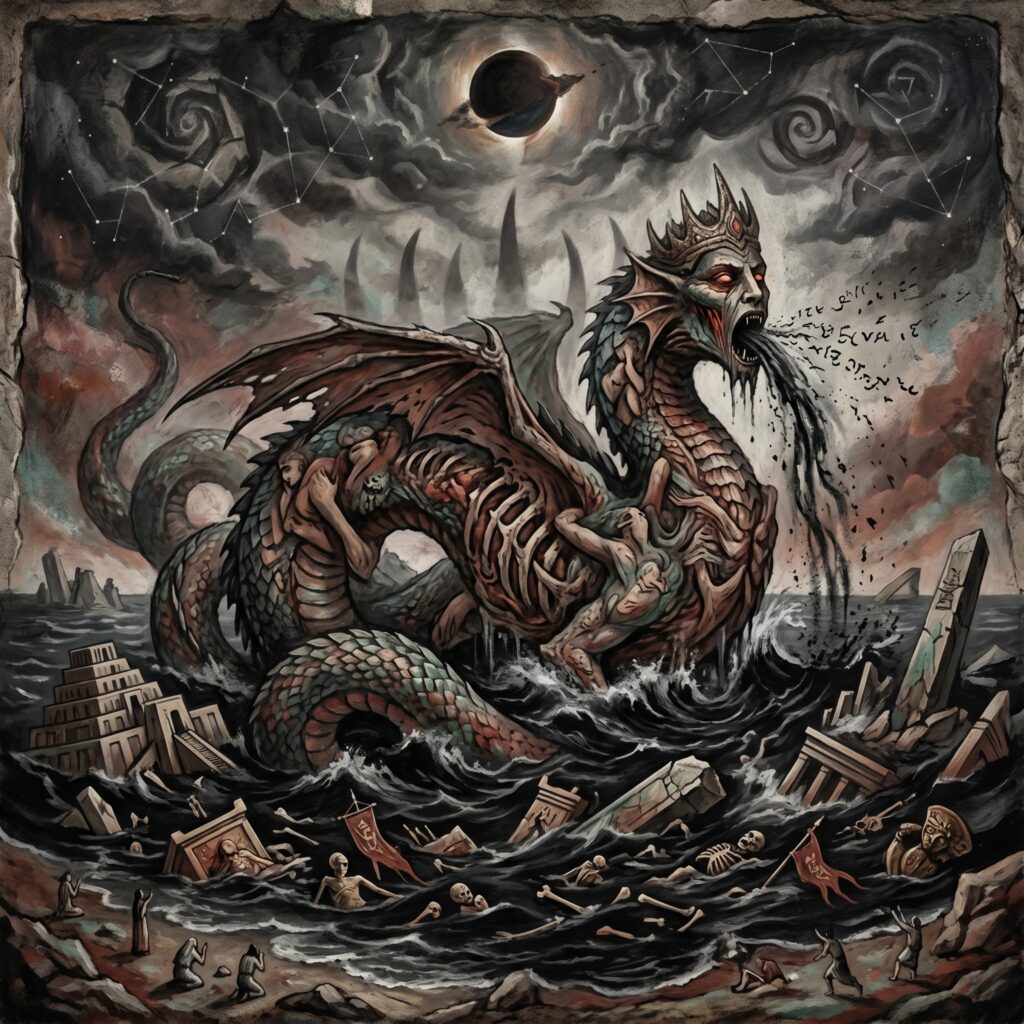
The Apocalypse of Tiamat is an initiatory ritual of destruction-as-unveiling. It is not an apocalypse in the Christian sense—no end of the world, no final judgment, no salvation of the righteous. The word apocalypse means “unveiling” or “lifting the veil.” The ritual strips away the layers of order that obscure the primordial chaos beneath, revealing Tiamat—the salt water dragon, the chaos monster of the Babylonian Enūma Eliš, the mother of gods and demons alike. She is not slain in this ritual. She is approached.
The Apocalypse of Tiamat draws from four sources. First, the PGM (Greek Magical Papyri) provides the structure of direct invocation, voces magicae, and the use of ritual offerings as transactional technology. Second, Tibetan sadhana practice provides the extended visualization sequence, the dissolution of ordinary reality, and the mantra as a vehicle of transformation—here stripped of Buddhist imagery and redeployed in a Babylonian frame. Third, Babylonian, Akkadian, and Sumerian magic provides the mythic architecture: Tiamat as the salt water sea, the eleven monsters of chaos, the Tablets of Destiny, and the primordial struggle between order (Marduk) and chaos (Tiamat). Fourth, the Book of Revelation (inverted) provides the apocalyptic structure—the seven seals, the trumpets, the bowls of wrath, the dragon of Revelation 12—but turned inside out. In the Christian Apocalypse, the dragon is defeated and order triumphs. In the Apocalypse of Tiamat, the dragon is the initiator. She does not lose. She unveils.
The practitioner does not banish. Does not cast a circle. Does not call upon archangels or divine names for protection. The Apocalypse of Tiamat is a ritual of exposure. You stand before the primordial dragon without armor. The unveiling happens whether you are ready or not. The ritual is structured as a Tibetan sadhana: preliminary offerings, visualization of the deity (Tiamat in her apocalyptic form), mantra recitation, dissolution of the visualization into the practitioner, and final offerings. The six directions receive offerings: north, south, east, west, above, below.
This is not a beginner ritual. The Apocalypse of Tiamat has unmasked practitioners who were not prepared for the chaos beneath their ordered selves. Do not perform it for curiosity, for power, or because you read about it in a book. Perform it only if you are willing to have your structures—psychological, spiritual, emotional—examined by the dragon who existed before order existed. Tiamat does not destroy. She reveals. But the revelation of chaos can feel like destruction.
What the Ritual Does
The Apocalypse of Tiamat produces a temporary unveiling of the primordial chaos that underlies all ordered reality. It is an initiatory apocalypse—not the end of the world, but the end of the practitioner’s world as they have constructed it. The ritual reveals the chaos beneath identity, beneath belief, beneath the structures of meaning that the practitioner has built. Tiamat is the agent of this unveiling.
The ritual produces three distinct outcomes when successful:
- Destruction of false order — The practitioner’s attachment to specific structures (beliefs, identities, relationships, hierarchies) is temporarily suspended. The Apocalypse of Tiamat reveals these structures as arbitrary—built on a foundation of chaos that they cannot control. This is not nihilism. It is recognition. The order was never as solid as you thought. Tiamat shows you the cracks.
- Unveiling of primordial chaos — The practitioner experiences Tiamat not as a monster to be slain but as a presence to be witnessed. She is vast, salt-dark, older than the gods. She does not speak in words. She speaks in pressure, in temperature drop, in the sensation of being submerged in deep water. The Apocalypse of Tiamat is not a conversation. It is an exposure.
- Initiatory transformation — After the ritual, the practitioner’s relationship to order and chaos is permanently shifted. Things that once felt stable (rules, hierarchies, certainties) may feel provisional. Things that once felt threatening (chaos, uncertainty, the unknown) may feel familiar. The effect is not comfort. It is clarity. Tiamat does not comfort. She unveils.
The Apocalypse of Tiamat is structured as a one-time initiatory crossing for most practitioners. Some return to the ritual to deepen the unveiling, to re-establish contact with the primordial current, or to celebrate the seasonal cycles of chaos (the dark moon, the winter solstice, the hour before dawn). Each performance of the Apocalypse of Tiamat is different. Tiamat does not repeat herself.
How It Is Performed
Setup for the Apocalypse of Tiamat
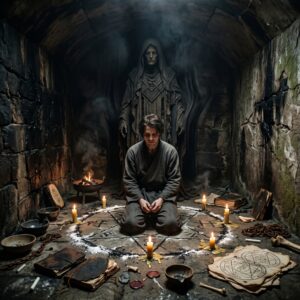
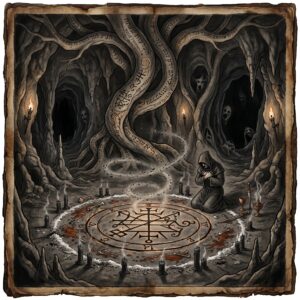
Space: A room that can be darkened. The floor should be bare or covered with a plain dark mat. No furniture in the center. Six markers placed at the six directions: north, south, east, west, above (a suspended object or a mark on the ceiling), below (a stone or bowl on the floor). The markers can be candles, stones, small bowls, or inscribed symbols. Each marker represents a direction from which chaos may enter.
Timing for the Apocalypse of Tiamat: The dark moon (when the sky is darkest) is optimal. The winter solstice (longest night). The hour before dawn (when the world is still and the veil is thin). Avoid solar noon, sunrise, or any high-light period. Tiamat is the salt water sea. Light is not her domain.
Objects needed for the Apocalypse of Tiamat:
- Six small bowls or offering vessels (for the six directions)
- Incense: myrrh, dragon’s blood, or saltwater-tinged resins (amber, ambergris substitute)
- A central marker: a bowl of salt water (representing Tiamat’s body), a black stone, or a dragon sigil (modern, created by the practitioner)
- A mala or counting cord (108 beads) for mantra recitation
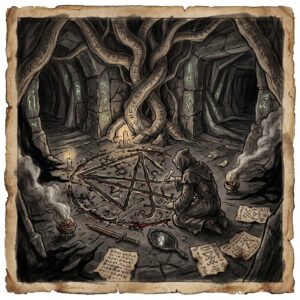
- A small knife or pointing tool (for tracing the apocalypse seals—not for cutting)
- Optional: a drum or rattle (for marking the eleven monsters)
Offerings for the Apocalypse of Tiamat (three offerings per direction):
Each of the six directions receives three offerings. The offerings are simple: water (salt water preferred), incense smoke, and a spoken word. The sequence is the same for each direction: first water, then incense, then word.
| Direction | Association | Offering (spoken word) |
|---|---|---|
| East | The rising chaos (where Marduk first confronted Tiamat) | “Tiamat, you were there before the sun.” |
| South | The burning chaos (fire as the boundary between land and sea) | “Tiamat, your salt extinguishes flame.” |
| West | The drowning chaos (sunset over the ocean, death of the day) | “Tiamat, the sun returns to your depths.” |
| North | The frozen chaos (the primordial deep, unmoving, patient) | “Tiamat, your cold is older than warmth.” |
| Above | The cosmic chaos (the salt water sea reflected in the night sky) | “Tiamat, the stars are your scales.” |
| Below | The chthonic chaos (the sea beneath the earth, the deep that never sees light) | “Tiamat, you are below as above.” |
Practitioner preparation for the Apocalypse of Tiamat: Fast for 12 hours (water only, salt water preferred). Bathe in salt water if possible—a handful of sea salt dissolved in a bath. Wear dark clothing with no ornament. No jewelry. No metal. No protective symbols. The Apocalypse of Tiamat is a ritual of exposure. Bring nothing that shields you from the unveiling.
Sequence of Actions for the Apocalypse of Tiamat
Step 1: Entering the salt
Enter the dark room. Light a single candle at the central marker (if using—some practitioners work in complete darkness). Sit facing the central marker. Close the eyes. Breathe slowly. Inhale 4 counts. Hold 4 counts. Exhale 8 counts. Visualize your breath as salt-scented—the smell of the sea, of deep water, of the primordial ocean. Do this for 5–10 minutes. The Apocalypse of Tiamat requires a calm nervous system. Agitation blocks the unveiling.
Step 2: The six offerings to Tiamat
Move to each direction in sequence. The Apocalypse of Tiamat uses the following order: East, South, West, North, Above, Below.
For each direction:
- Raise the bowl of salt water. Pour a few drops onto the floor or into a central collecting bowl. Recite: “Water of Tiamat. Salt of the primordial deep. I offer what is yours.”
- Light the incense. Wave it toward the direction. Recite: “Smoke of Tiamat. Breath of the dragon. I offer what is yours.”
- Recite the spoken word offering for that direction (see table above). Speak clearly, without force. The Apocalypse of Tiamat is not a command. It is an invitation to unveil.
After completing all six directions, return to the center.
Step 3: The invocation of the eleven monsters
In the Enūma Eliš, Tiamat creates eleven monsters to serve as her army: the serpent, the dragon, the furious serpent, the great lion, the demon, the scorpion-man, the fish-man, the bull-man, the lion-demon, the eagle, and the raven (sources vary on the exact list). The Apocalypse of Tiamat invokes these monsters not as separate entities but as aspects of Tiamat’s power—the eleven faces of chaos.
Recite the eleven names, slowly, with a pause between each. Use a drum or rattle to mark each name if desired.
Ušumgallu (the great serpent — Usumgallu)
Mušmaḫḫū (the exalted serpent — Mushmakkhu)
Bašmu (the venomous serpent — Bashmu)
Ugallu (the great lion — Ugallu)
Girtablullû (the scorpion-man — Girtablullu)
Kulullû (the fish-man — Kulullu)
Kusarikku (the bull-man — Kusarikku)
Uridimmu (the lion-demon — Uridimmu)
Anzû (the eagle — Anzu)
Lilû (the raven — Lilu — not Lilith)
Mušḫuššu (the dragon — Mushusshu)
After reciting the eleven names, pause. Feel the shift in the room. The Apocalypse of Tiamat has called the edges of chaos. Do not be alarmed if the temperature drops or the air thickens. This is Tiamat’s response.
Step 4: Extended visualization of Tiamat — the dragon of the apocalypse
Close the eyes. This visualization will take 20–30 minutes. Do not rush. The Apocalypse of Tiamat unfolds in its own time.
Phase 4A: The sea rising (5–10 minutes)
Visualize the floor beneath you becoming salt water. Dark water. Not blue—black and grey, the color of the deep sea where light does not reach. The water rises slowly. Ankle. Calf. Knee. Thigh. Waist. Chest. Neck. You are submerged. You are floating in the salt water sea that existed before the gods, before the sky, before the earth. This is Tiamat’s body. You are inside her.
Do not fight the water. Do not hold your breath. Breathe normally. The water is not real. The sensation of drowning is not physical. The Apocalypse of Tiamat asks you to trust that you will not drown. The unveiling requires surrender.
Phase 4B: Tiamat emerging (5–10 minutes)
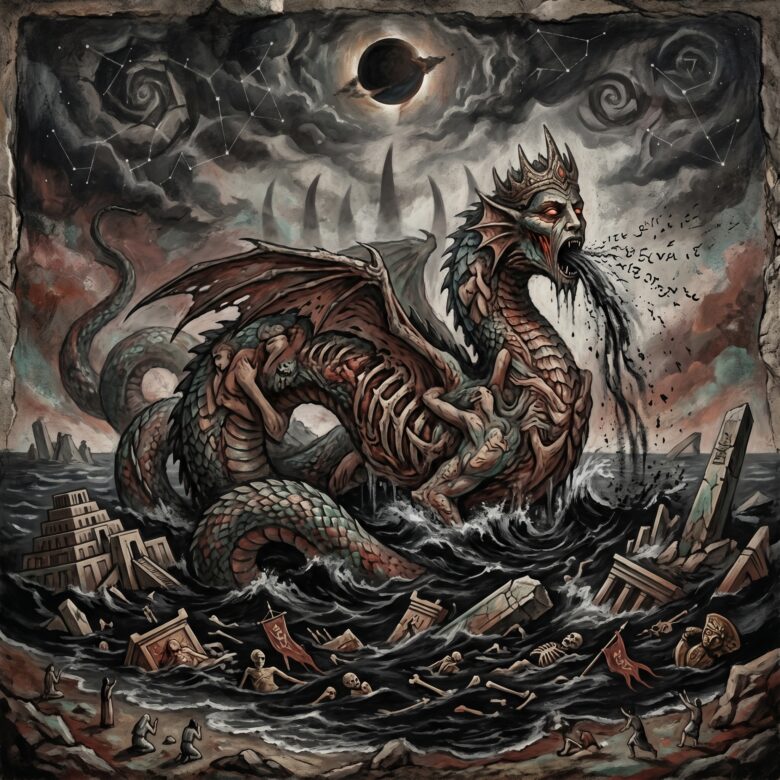
From the depths below, a shape rises. It is vast—so vast that you cannot see its edges. Scales the size of shields. Eyes like dark moons. A mouth that opens sideways, not up and down, lined with teeth that are not teeth but stalactites of salt. Tiamat has no single form. She is dragon, serpent, sea, abyss. The Apocalypse of Tiamat shows you her in the form your mind can tolerate—but she is not that form. She is what lies beneath all forms.
She is not hostile. She is not kind. She is older than both. Her presence is pressure—the pressure of deep water, the pressure of something that has existed since before existence. The Apocalypse of Tiamat is the experience of being witnessed by something that does not judge because judgment is a later invention.
Phase 4C: The unveiling (5–10 minutes)
Tiamat looks at you. Not with eyes—with something deeper. The look passes through your skin, your bones, your thoughts, your memories, your beliefs. She sees the structures you have built to protect yourself from chaos: your identity, your story, your certainties. The Apocalypse of Tiamat does not destroy them. It shows you that they are floating on her surface, like foam on the sea. She is not threatened by them. She is not impressed by them. She simply sees.
Hold the gaze as long as you can. If you need to look away, look away. The Apocalypse of Tiamat does not force. But if you can hold the gaze, something shifts. The veil lifts. You see that you are not separate from the chaos. You are chaos pretending to be order. Tiamat is not a monster to be slain. She is your mother. Your origin. Your end.
Step 5: Mantra of Tiamat — the unveiling current
Recite the Tiamat mantra. This is not a name—it is a voces magicae drawn from the Enūma Eliš and PGM sources, vibrating the primordial sound of the salt water sea.
TIAMAT — TAMTU — NAMMU — UN
Recite as a continuous cycle. Each cycle is four sounds:
TIAMAT (tee-ah-maht)
TAMTU (tahm-too — Akkadian for “sea”)
NAMMU (nahm-moo — Sumerian primordial sea goddess, Tiamat’s antecedent)
UN (oon — the sound of being, existence, first vibration)
Recite 108 times, using the mala or counting cord. This will take approximately 15–20 minutes. Maintain a steady rhythm. The sound should be low, throaty, like water moving over stones. Do not force volume. The Apocalypse of Tiamat is not a shout. It is a resonance.
Variation for deeper unveiling: After the first 108 repetitions, recite 21 repetitions of the extended mantra: TIAMAT MUŠḪUŠŠU TIAMAT. “Tiamat, dragon, Tiamat.” This binds the dragon form to the sea form.
Step 6: The dissolution — Tiamat returning to the deep
The unveiling is complete. Tiamat begins to sink back into the depths. Visualize her descending slowly—eyes first, then mouth, then head, then the vast body. The water level drops. Neck. Chest. Waist. Thighs. Knees. Ankles. Floor. You are sitting on solid ground again. The salt water recedes. But the salt remains on your skin. The Apocalypse of Tiamat leaves residue.
Recite: “Tiamat has unveiled. Tiamat returns to the deep. I am seen. I am salt.”
Step 7: The final six offerings — sealing the apocalypse
Repeat the six offerings from Step 2, but in reverse order: Below, Above, North, West, South, East. This seals the Apocalypse of Tiamat. The unveiling is complete. The directions are returned to their ordinary state.
At each direction, after the three offerings, recite: “The veil is lifted. The veil is restored. Tiamat has come. Tiamat has gone. Salt remains.”
Return to the center.
Step 8: Grounding after the Apocalypse of Tiamat
Eat something salty—a pinch of sea salt on bread, olives, saltwater fish if available. Drink a full glass of water. Wash your hands and face with salt water (or plain water if salt is not available). Sit for 10–15 minutes. The Apocalypse of Tiamat leaves the nervous system expanded. The unveiling continues subtly for hours or days.
Do not drive immediately after this ritual. Do not engage in important decisions. The Apocalypse of Tiamat reveals the chaos beneath order. Your judgment may be temporarily altered.
What Is Happening Structurally
The Apocalypse of Tiamat ritual operates on five structural layers.
The six directions as a chaos-mandala: In Tibetan sadhana, offerings are made to the six directions (the four cardinal directions plus above and below) to establish a mandala—a sacred space that contains the deity. The Apocalypse of Tiamat inverts this. The six directions are not a container that protects the practitioner from chaos. They are a container that invites chaos to enter from every possible angle. Tiamat is approached from all directions simultaneously. There is no “back” to the ritual space. The unveiling is total.
The three offerings as transactional technology: Each direction receives three offerings: water (Tiamat’s body), incense (Tiamat’s breath), and a spoken word (Tiamat’s name in its directional aspect). This tripartite structure is adapted from PGM and Babylonian offering protocols. The repetition (six directions × three offerings = eighteen offerings total) establishes a rhythmic pattern that shifts the practitioner’s attention from ordinary space to ritual space. The Apocalypse of Tiamat requires this shift. Without the offerings, the visualization remains shallow.
The eleven monsters as neural anchors: The eleven monsters of Tiamat are not external entities. They are cognitive anchors—each name triggers a specific aspect of chaos. Ušumgallu (great serpent) = the chaos of sinuous, indirect threat. Mušmaḫḫū (exalted serpent) = the chaos of overwhelming scale. Ugallu (great lion) = the chaos of predatory power. Reciting the eleven names in sequence activates a cascade of chaos-associations, priming the practitioner’s nervous system for the unveiling. The Apocalypse of Tiamat uses the monsters not as threats but as keys.
The visualization of submersion as boundary dissolution: The sequence of the sea rising (ankle → calf → knee → thigh → waist → chest → neck → submersion) systematically dismantles the practitioner’s sense of being separate from the environment. Each rising level of water dissolves another boundary between self and other. By the time the practitioner is fully submerged, the ego boundary has relaxed. This is a standard technique in Tibetan jhāna meditation (dissolution of the body boundary) and PGM immersion rituals (baptismal submersion as initiatory death). The Apocalypse of Tiamat adapts both.
The mantra as frequency tuning: TIAMAT — TAMTU — NAMMU — UN is a four-part voces magicae. TIAMAT is the direct name from the Enūma Eliš. TAMTU is the Akkadian common noun for sea, grounding the name in the physical element. NAMMU is the Sumerian antecedent, acknowledging the older layer of the current. UN is the sound of existence itself—a proto-syllable found in PGM and Tantric sources. Repetition (108 times, a sacred number in both South Asian and Mesopotamian traditions—108 bricks in a ziggurat, 108 beads in a mala) creates a resonant frequency that alters the practitioner’s baseline neurological state. The Apocalypse of Tiamat uses this frequency to lower resistance to the unveiling.
Variations Across Traditions
Babylonian / Akkadian / Sumerian influence on the Apocalypse of Tiamat: The mythic architecture—Tiamat, the eleven monsters, the primordial sea—is drawn directly from the Enūma Eliš (Tablets I–IV). However, the ritual inverts the original narrative. In the Enūma Eliš, Marduk slays Tiamat and creates order from her body. In the Apocalypse of Tiamat, she is not slain. She is approached as an initiator. The ritual is closer to the older Sumerian layer (Nammu as the primordial mother, never slain) than to the Babylonian political theology.
PGM influence on the Apocalypse of Tiamat: The direct voces magicae (TIAMAT TAMTU NAMMU UN), the six-direction offering structure, and the use of salt water as a ritual substance are adapted from PGM practices. The PGM contains no Tiamat, but its technical approach to invocation (repetition, voces as technology, offerings as transaction) is applied here.
Tibetan sadhana influence on the Apocalypse of Tiamat: The visualization sequence (deity emerging from the void → mantra recitation → dissolution of the deity into the practitioner) is directly adapted from Tibetan Buddhist deity yoga. In traditional sadhana, the practitioner visualizes a deity (like Tara or Vajrakilaya), recites the deity’s mantra, and then dissolves the deity into their own heart, receiving the deity’s qualities. The Apocalypse of Tiamat replaces the Buddhist deity with Tiamat—but the structure is identical. The Tibetan technique of dissolving the practitioner’s body boundary into the environment is also adapted here.
The Book of Revelation (inverted) as apocalyptic structure: The Christian Apocalypse (Revelation 12) features a dragon—”that ancient serpent called the devil and Satan”—who is defeated by Michael and cast out of heaven. The Apocalypse of Tiamat inverts this. Tiamat is not defeated. She is the initiator. The “apocalypse” is not the end of the world. It is the unveiling of the dragon as the origin, not the enemy. The seven seals, trumpets, and bowls of Revelation are not used here; the six directions replace the septenary structure. But the apocalyptic tone—the unveiling of hidden things, the confrontation with the dragon, the transformation of the visionary—is borrowed and inverted.
Limits and Breakdown Points
What disrupts the Apocalypse of Tiamat ritual:
- Light. Any ambient light disrupts the submersion visualization. The Apocalypse of Tiamat requires darkness—not symbolic darkness, but actual darkness. Tiamat is the deep sea. Light cannot reach her.
- Banishing. If the practitioner has performed LBRP, Star Ruby, or any similar banishing ritual before the Apocalypse of Tiamat, the space may be too “clean” for chaos to enter. Tiamat will not enter a banished space. Wait at least 24 hours.
- Fear of drowning. The submersion visualization triggers genuine panic in some practitioners—not symbolic fear, but somatic fear of being underwater. The Apocalypse of Tiamat is not for these practitioners. Do not force the visualization.
- Unresolved trauma. The unveiling may trigger intrusive material. Tiamat does not censor. If the practitioner is not prepared to have their structures examined, the Apocalypse of Tiamat can destabilize.
Where the Apocalypse of Tiamat weakens:
- First attempt. The first unveiling is often shallow. The practitioner is anxious, attached to order, afraid of chaos. The Apocalypse of Tiamat deepens with practice. Each crossing reveals more.
- Distracted preparation. If the practitioner does not fast, does not bathe in salt water, or does not spend time in pranayama, the nervous system remains agitated. Tiamat cannot be heard through agitation.
- Poor timing. Performing the Apocalypse of Tiamat during a high-light period (solar noon, summer solstice day) produces weak results. The ritual requires darkness—literal and symbolic.
Common misapplications of the Apocalypse of Tiamat:
- Seeking to control Tiamat. The Apocalypse of Tiamat is not an evocation. You do not command Tiamat. You do not bind her. You stand before her and are unveiled. Attempts to coerce or command will be ignored.
- Seeking protection. The Apocalypse of Tiamat has no protective circle, no divine names, no archangels. Tiamat is the protection. If you need a circle, this ritual is not for you.
- Performing the Apocalypse of Tiamat for spectacle. The ritual is not a performance. It is not a group event (except for very experienced practitioners). It is a solitary initiatory descent. Do not film it. Do not livestream it. Tiamat does not perform.
Practitioner Notes
Who the Apocalypse of Tiamat suits:
- Experienced meditators (at least 3 years of regular practice, ability to sit for 60 minutes without movement)
- Practitioners who have already crossed an abyss equivalent (Chavajoth, the Qliphothic spheres, etc.)
- Those with stable grounding and no active mental illness (the unveiling will destabilize the unstable)
- Practitioners who are not afraid of chaos—who have already done significant shadow work
- Those comfortable with invitational, non-coercive ritual frames (Tiamat is not commanded)
Intensity level of the Apocalypse of Tiamat: Very high. This is not a gentle meditation. It is an unveiling—the destruction of false order and the confrontation with primordial chaos. Practitioners report: intense pressure, temperature drop, difficulty breathing during the submersion visualization, tears, shaking, time distortion, and in rare cases, temporary depersonalization lasting hours or days. Do not perform the Apocalypse of Tiamat and then drive.
Stability of results with the Apocalypse of Tiamat: The first unveiling is often shallow. The tenth may be profound. The Apocalypse of Tiamat deepens with practice. However, repeated performance without integration produces diminishing returns. The practitioner becomes habituated to the unveiling and stops being transformed by it. Integration time (weeks to months) is essential.
Independence vs dependency on the Apocalypse of Tiamat: The ritual is designed to empower the practitioner, not create dependency on Tiamat. However, some practitioners become attached to the unveiling experience itself—seeking the sensation of chaos as an escape from ordinary life. This is misuse. The Apocalypse of Tiamat is a door, not a destination.
Compatibility of the Apocalypse of Tiamat with other systems:
- Incompatible with: Any banishing-heavy system (Golden Dawn, Wiccan circle casting, Solomonic evocation). Tiamat will not enter a banished space.
- Compatible with: Qliphothic sphere work (the Void of Chavajoth is a precursor to Tiamat), non-dual meditation systems (Advaita Vedanta, certain Buddhist lineages), PGM-style direct invocation.
- Neutral with: Chaote practices (the Apocalypse of Tiamat is more structured than typical chaote ritual, but the chaos current aligns with chaote aesthetics), Thelemic Current (Crowley’s system includes some Babylonian material but also includes banishing—adapt accordingly).
The bottom line on the Apocalypse of Tiamat: This ritual is not for everyone. It is not for beginners. It is not for the curious. It is for practitioners who have reached the limit of order—who have built their structures, crossed their abysses, and are now ready to meet the chaos that was there before any of it existed. The Apocalypse of Tiamat does not destroy your order. It shows you that order was floating on her surface all along. The veil lifts. You see. Then you choose—to rebuild, to restructure, or to stay with the salt.
If you are called to the Apocalypse of Tiamat, prepare. Fast. Bathe in salt water. Darken the room. Offer to the six directions. Call the eleven monsters. Submerge. See. Return. Then live with salt in your blood.
Tiamat is not your enemy. She is your origin. The Apocalypse is not the end. It is the unveiling.