Overview
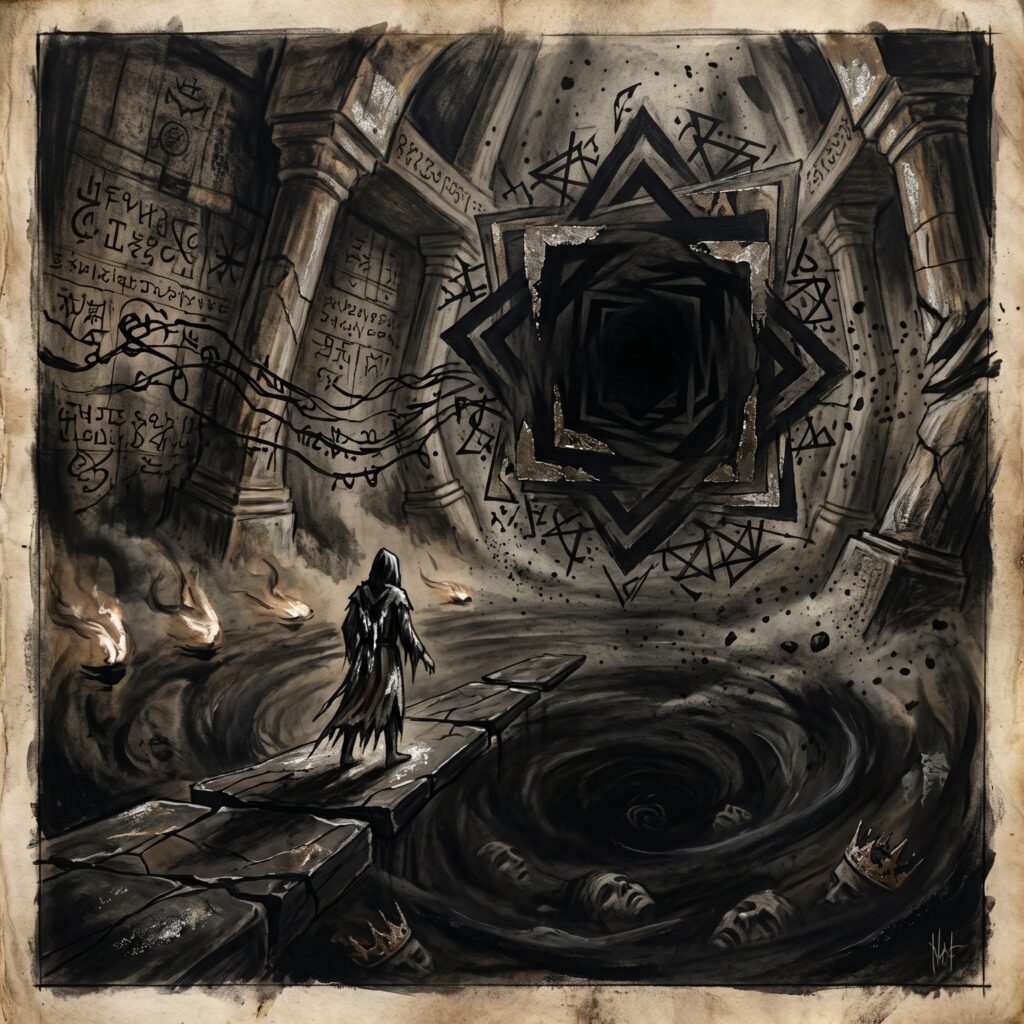
The Void of Chavajoth is an initiatory ritual of pure dissolution. It is not a crossing in the Crowleyan sense—no angel, no guardian, no magical formulas, no divine names. It is a meditative descent into the place before form. The ritual draws from PGM-style invocation (direct voces magicae, rhythmic repetition, and confrontation with the formless), Qliphothic current work (Chavajoth as the abyss beneath the Tree of Death), and Tibetan sadhana techniques (extended visualization, dissolution sequences, and mantra as a vehicle of transformation)—but stripped of Buddhist imagery, deities, or cultural markers. The practitioner enters the Void alone, without protection, without banishing, without sheltering circles.
The Void of Chavajoth is not a place. It is the absence of place. It is where potential exists before it becomes anything. In Qliphothic Kabbalah, Chavajoth (sometimes Chavayoth or Chawah) is the abyssal current beneath the sphere of Da’ath—the “false sephirah” that sits between the upper and lower Tree of Life. Where Da’ath is knowledge obscured, Chavajoth is the ground of unknowing. In the Tree of Death, Chavajoth is not a sphere but the emptiness between spheres—the gap that must be crossed to move from the Qliphoth proper to the Night Side.
The ritual uses two primary mantras. The first is CHAVAJOTH, the name of the Void itself—a voces magicae drawn from Qliphothic sources, pronounced KHA-vah-yoth. The second is the Reverse Tetragrammaton: HEH-VAU-HEH-YOD (HVHY). In normative Kabbalah, the Tetragrammaton YHVH (Yod-Heh-Vau-Heh) represents the creative force of order, the emanation of form from formlessness. The Reverse Tetragrammaton HVHY is its shadow—the dissolution of form back into formlessness, the uncreation current. Where YHVH creates, HVHY returns. The Void of Chavajoth is the engine of that return.
This ritual is initiatory. It is not performed for results, for contact, for information, or for power. It is performed to unmake what the practitioner thinks they are, so that what remains is not a construct but a sovereign awareness. The Void of Chavajoth strips identity, memory, attachment, and fear—not through violence, but through absence. You enter with intention. You leave with what cannot be taken.
Do not perform this ritual casually. Do not perform it for entertainment, curiosity, or because you read about it in a book. The Void of Chavajoth has unmoored practitioners for days, weeks, permanently in some cases. You must have stable grounding, a functioning support structure, and no active psychosis or untreated trauma. The Void will find every crack.
What the Ritual Does
The Void of Chavajoth produces a temporary dissolution of the practitioner’s ordinary sense of self. It is an initiatory crossing—not a crossing of a literal barrier, but a crossing of the threshold between constructed identity (the persona, the ego, the narrative self) and sovereign awareness (the observer that remains when all constructs are removed). The Reverse Tetragrammaton HVHY is the key that unlocks this threshold. Where the standard Tetragrammaton YHVH is the current of creation (Yod = fire/father, Heh = mother/uterus, Vau = son/phallus, Heh = daughter/womb), the Reverse Tetragrammaton HVHY is the current of dissolution: Heh (womb returning to void), Vau (son dissolving), Heh (mother uncreating), Yod (fire extinguishing).
The ritual produces three distinct outcomes when successful:
- Ego dissolution — The practitioner’s sense of being a separate, continuous self with a name, a history, and a future temporarily ceases. This is not amnesia. It is not fragmentation. It is the recognition that the self is a process, not a thing. The Void of Chavajoth, vibrated through the Reverse Tetragrammaton HVHY, reveals this directly, not conceptually.
- Confrontation with the formless — The practitioner experiences the Void not as an empty space but as a presence of absence. The Void of Chavajoth is not nothing—it is the potential from which nothing and everything emerge. The Reverse Tetragrammaton HVHY is the sound of that potential collapsing into itself. Reports include: vast darkness, a sense of being suspended, pressure, silence more total than ordinary silence, sometimes a distant humming or rushing sound—the HVHY current audible as a subsonic drone.
- Return with altered perception — After the ritual, the practitioner’s relationship to identity, fear, desire, and attachment is permanently shifted. Things that once felt solid (reputation, possessions, relationships, opinions) may feel transparent. Things that once felt threatening may feel neutral. The effect is not euphoria or bliss—it is clarity. The Reverse Tetragrammaton HVHY continues to resonate subtly in the background for days after a deep crossing.
The Void of Chavajoth is not a one-time crossing. Some practitioners cross once and never need to cross again. Others return to the Void of Chavajoth periodically to refresh the dissolution, to test their attachment, or to go deeper. Each crossing is different. The Void does not repeat itself.
How It Is Performed
Setup for the Void of Chavajoth
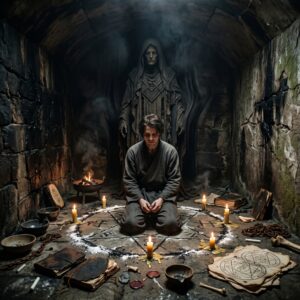
Space: A completely dark room. No windows. Or blackout curtains that block all light. The room should be silent—no electronics, no street noise, no hum. If absolute silence is impossible, the practitioner may wear noise-canceling headphones or earplugs. The floor should be bare or covered with a plain dark mat. No furniture in the center.
Timing for the Void of Chavajoth: Midnight to 3 a.m. is traditional for Qliphothic work. Dark moon. No planetary hour associations—the Void of Chavajoth is outside planetary influence. Avoid solar noon, sunrise, or any high-light period. Some practitioners prefer the hour before dawn (when the world is darkest and stillest) or the winter solstice (longest night). The Reverse Tetragrammaton HVHY is most potent when the sun is below the horizon—daylight anchors form, and the Void requires formlessness.
Objects needed for the Void of Chavajoth:
- A single black candle (optional—some practitioners work in complete darkness without any light)
- A small bowl of water (for the offering)
- A small bowl of salt or earth (for grounding after)
- A meditation cushion or mat (plain, dark)
- Optional: a singing bowl or bell (for marking the threshold)
- A mala or counting cord (108 beads) for mantra recitation
Practitioner preparation for the Void of Chavajoth: Fast for 12 hours before the ritual (water only). Bathe or wash hands and face. Wear plain dark clothing—black, grey, or deep navy. No jewelry. No metal. No ritual tools from other systems. The body is the only vessel for the Void of Chavajoth. No banishing. No protective circle. No divine names. The Reverse Tetragrammaton HVHY is the only name invoked.
The preparation is minimal because the Void of Chavajoth requires minimal interference. Every symbol, every object, every protective measure is an attachment. The Void strips attachments. Do not bring what you are not willing to lose.
Sequence of Actions for the Void of Chavajoth
Step 1: Entering the dark
Enter the room. Light the single black candle (if using). Place it in the center. Sit facing it. Close the eyes. Breathe slowly. Inhale 4 counts. Hold 4 counts. Exhale 8 counts. Repeat this pranayama for 5–10 minutes until the body settles and the mind becomes still. Do not skip this step. The Void of Chavajoth requires a calm nervous system. Agitation blocks the descent. The Reverse Tetragrammaton HVHY will not vibrate properly through a tense body.
Step 2: The offering to Chavajoth
Recite aloud, slowly, with attention:
“I offer nothing to the Void of Chavajoth. I have nothing that the Void requires. I bring no gift because the Void of Chavajoth has no need. I come empty. This is the only offering. By HVHY, the Reverse Tetragrammaton, I dissolve.”
Place a single drop of water from the bowl onto the floor in front of you. This is not an offering to a deity. It is a symbolic act of release—water as formlessness, water as dissolution, water as the boundaryless element. The Reverse Tetragrammaton HVHY is the seal on this offering.
Step 3: First invocation of the Void of Chavajoth with CHAVAJOTH
Recite aloud, with equal spacing between syllables, rhythmically:
CHAVAJOTH. CHAVAJOTH. CHAVAJOTH. CHAVAJOTH. CHAVAJOTH. CHAVAJOTH. CHAVAJOTH.
Seven repetitions. The name of the Void is the key. Do not translate it. Do not analyze it. The sound is the technology. CHAVAJOTH is pronounced roughly “KHA-vah-yoth”—the CH as in the Hebrew chet (throaty, guttural), the J as a soft Y. If you cannot produce the guttural, an aspirated H suffices. Accuracy matters less than intention.
Step 4: Mantra of the Reverse Tetragrammaton HVHY
Now recite the Reverse Tetragrammaton. This is the dissolution current. The syllables are:
HEH — VAU — HEH — YOD
Pronounced: HEH (as in “hey” with an exhalation), VAU (as in “vow” but shorter, more like “vah-oo” elided), HEH (again), YOD (as in “yode”—rhymes with “mode”).
Recite the Reverse Tetragrammaton HVHY in cycles. Each cycle is the four syllables spoken as one breath: HEH-VAU-HEH-YOD. Do not pause between syllables. The sound should be continuous, like a single word: HEHVAUHEHYOD.
Recite 108 times, using the mala or counting cord. This will take approximately 15–20 minutes. Maintain the rhythm. If your attention wanders, return to the sound. The Reverse Tetragrammaton HVHY is not a prayer. It is a technology. Each repetition weakens the attachment to form.
Variation for deeper dissolution: After the first 108 repetitions of HVHY, recite 21 repetitions of the combined mantra: CHAVAJOTH HVHY. This binds the name of the Void to the Reverse Tetragrammaton, creating a single dissolution current.
Step 5: Extended visualization of the Void of Chavajoth
Close the eyes. This visualization will take 15–30 minutes. Do not rush. The Void of Chavajoth unfolds in its own time. The Reverse Tetragrammaton HVHY continues silently in the background—imagine its vibration as the floor beneath your awareness.
Phase 5A: The floor dissolving (5–10 minutes)
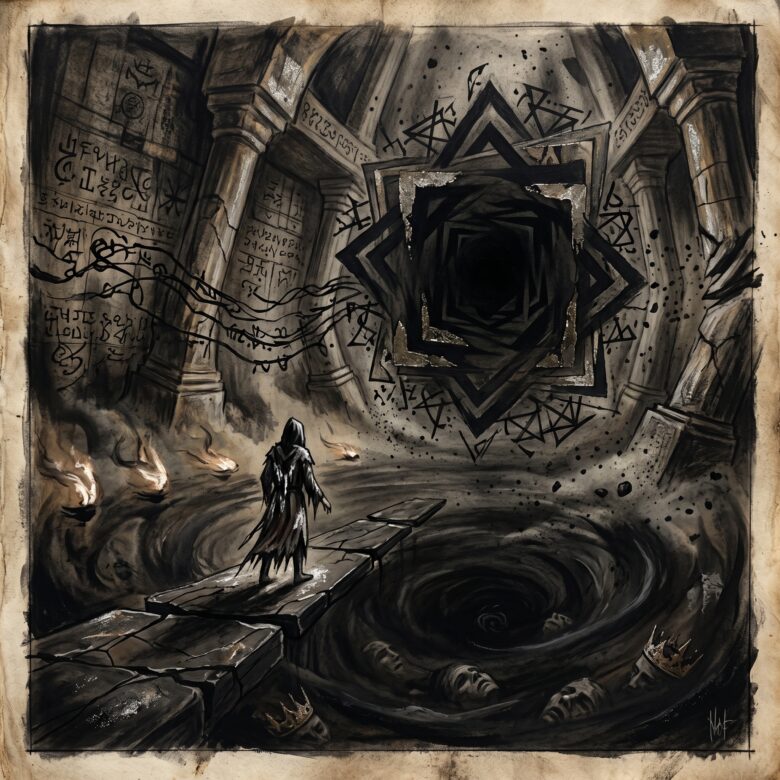
Visualize the floor beneath you becoming transparent. Not breaking—dissolving. The floor becomes a membrane. Beneath the membrane is darkness. Not the darkness of a room with the lights off. A deeper darkness. A darkness that has no surface, no bottom, no end. The membrane thins. You feel the Void of Chavajoth pulling you down—not violently, but with the gentle gravity of a deep ocean current. The Reverse Tetragrammaton HVHY is the sound of the membrane dissolving.
Do not fight the pull. Do not resist. The Void of Chavajoth does not harm. It absorbs.
Phase 5B: The body dissolving (5–10 minutes)
Visualize your body from the feet upward. Toes dissolve into grey mist. Ankles. Calves. Knees. Thighs. Hips. The dissolving is not painful. It feels like warmth spreading, then fading. As each part dissolves, vibrate the Reverse Tetragrammaton HVHY silently in your mind—HEH-VAU-HEH-YOD for the feet, again for the ankles, again for the calves. Each repetition of HVHY dissolves another segment.
The lower body is gone. You are sitting on nothing. The upper body remains. Belly. Chest. Shoulders. Arms. Hands. Fingers. Each part dissolves in sequence. You are a torso, a neck, a head.
Then the neck dissolves. You are a head floating in the Void of Chavajoth. Then the head dissolves from the outside in. Ears. Cheeks. Nose. Mouth. Eyes. Then the interior of the head—the thoughts, the memories, the voice that narrates everything. That dissolves last, with a final silent HVHY. You are not thinking. You are not remembering. You are not planning. You are awareness without content. You are the Void of Chavajoth observing itself. The Reverse Tetragrammaton has returned you to before the beginning.
Phase 5C: The suspension (5–10 minutes)
You are nowhere. You are nothing. You are suspended in the Void of Chavajoth. There is no up, no down. No light, no dark. No hot, no cold. No sound, no silence. Just presence without object. This is the Void of Chavajoth. The Reverse Tetragrammaton HVHY is now silent—it has dissolved even itself.
Stay here for as long as you can. Do not seek visions. Do not seek voices. Do not seek any experience. The Void of Chavajoth is not a content provider. It is the absence of content. If you see images, let them go. If you hear sounds, let them go. If you feel emotions, let them go. Return to the Void of Chavajoth.
A clock in another room. A distant car. A muscle twitch. These are not disruptions. They are anchors to the body. Do not panic. The Void of Chavajoth does not disappear because of a sound. Return to the dissolution.
Step 6: The mantra of return
When you are ready to return—or when your body forces return (cramps, cold, discomfort, exhaustion)—recite the mantra of return. This is the only time you use force in the Void of Chavajoth. You will reverse the Reverse Tetragrammaton.
Recite aloud, firmly, with intention. Begin with the Reverse Tetragrammaton HVHY, then reverse the order to YHVH (the standard Tetragrammaton, the creative current). The sequence is:
HVHY — YHVH
HVHY — YHVH
HVHY — YHVH
Seven repetitions.
Then recite:
AHAM. AHAM. AHAM. SO’AHAM.
AHAM is “I am” in Sanskrit (Tantric adaptation). SO’AHAM is “I am That”—the recognition of identity with the absolute. In the Void of Chavajoth, you recite this not to claim identity but to reclaim identity. You are returning to form. You are choosing to be a self again. The reversal from HVHY to YHVH signals to the nervous system that dissolution is complete and creation can resume.
Step 7: Rebuilding the body
Visualize the body rebuilding from the center outward. Begin at the heart. A point of grey light. Then a warm sensation spreading. Chest. Ribs. Spine. Then shoulders, arms, hands. Then belly, hips, thighs. Then neck, head, face. Then the feet. The body is whole again. You are sitting on the floor. The floor is solid. The candle (if lit) is still burning.
As each part rebuilds, recite YHVH silently (the standard Tetragrammaton, pronunciation varies; YOD-HEH-VAU-HEH). This is the creative current, re-establishing form where the Reverse Tetragrammaton removed it.
Open your eyes. Blink slowly. Look at the candle. Look at your hands. Touch the floor. Touch your face. Say aloud: “I am here. I have returned from the Void of Chavajoth. By YHVH, I am formed. By HVHY, I may dissolve again.”
Step 8: Grounding
Take the bowl of salt or earth. Rub a pinch on your wrists, the back of your neck, the soles of your feet. Drink a full glass of water. Eat something simple (bread, rice, fruit). Do not rush into activity. Sit for 10–15 minutes. The Void of Chavajoth leaves the nervous system expanded. Sudden transitions (driving, social interaction, bright light) can be jarring. The Reverse Tetragrammaton HVHY may continue to vibrate subtly for hours. This is normal. Do not re-enter the Void without preparation. Let the current settle.
What Is Happening Structurally
The Void of Chavajoth ritual operates on five structural layers, with the Reverse Tetragrammaton HVHY as the primary engine.
The Reverse Tetragrammaton HVHY as dissolution current: The standard Tetragrammaton YHVH (Yod-Heh-Vau-Heh) in Kabbalistic thought represents the four elements of creation: Yod (fire, the father principle), Heh (water, the mother principle), Vau (air, the son principle), Heh (earth, the daughter principle). The sequence is one of emanation—from the highest (Yod) to the lowest (final Heh). The Reverse Tetragrammaton HVHY reverses this flow. It begins with Heh (earth/womb), moves to Vau (air/son), then Heh (water/mother), and ends with Yod (fire/father). The current moves from form back to formlessness, from manifestation back to potential. Each repetition of HVHY is a cycle of uncreation. The Qliphothic Void of Chavajoth is the space where this uncreation current operates.
CHAVAJOTH as the name of the Void: Where the Reverse Tetragrammaton HVHY is the current, CHAVAJOTH is the destination. CHAVAJOTH has no meaning in normative Hebrew or Aramaic. It is a voces magicae—a sound whose power is in its vibration, not its translation. In Qliphothic sources, Chavajoth (or Chavayoth) is sometimes identified with the “howling” of the abyss, the sound of form collapsing into formlessness. The combined mantra CHAVAJOTH HVHY binds the name of the Void to the dissolution current. The practitioner becomes a conduit for both.
Sensory deprivation as a technology of dissolution: The dark room, silence, and lack of furniture remove ordinary sensory anchors. Without visual reference points, the brain’s spatial mapping system relaxes. Without sound, the auditory processing system quiets. The Reverse Tetragrammaton HVHY provides a sonic anchor that is not spatial—it is vibrational, not directional. This creates the conditions for the nervous system to decouple from ordinary self-location.
Pranayama as a bridge to altered states: The 4-8 breathing pattern (inhale 4, exhale 8) activates the parasympathetic nervous system. Heart rate slows. Blood pressure drops. The body enters a state of relaxation that is conducive to meditative dissolution. Without this step, the Void of Chavajoth produces agitation, not dissolution. The extended exhale is the key. The Reverse Tetragrammaton HVHY is most effective when the body is calm.
Systematic dissolution visualization as ego deconstruction with HVHY: The sequence (floor → lower body → upper body → head → thoughts) mirrors the way the brain constructs the sense of self. The self is not a thing. It is a process: boundary mapping (floor/body boundary), proprioception (body map), interoception (internal body sensations), narrative (the inner monologue). Dissolving these in reverse order (external boundary → body → internal sensations → narrative) systematically dismantles the mechanisms that produce the sense of a separate self. The Reverse Tetragrammaton HVHY is applied at each stage as a “dissolution count” (feet: HVHY, ankles: HVHY, etc.). This couples the sound to the sensation of dissolution.
The reversal from HVHY to YHVH as a cognitive reset: Returning from the Void of Chavajoth requires reversing the current. The mantra HVHY — YHVH (repeated seven times) signals to the nervous system that dissolution is complete and creation can resume. YHVH is the creative current—the Tetragrammaton as it appears in normative Kabbalah. By reciting YHVH after HVHY, the practitioner re-establishes the flow of form. Without this reversal, some practitioners remain in a dissociated state for hours or days. The Void of Chavajoth provides the exit. Use it.
Variations Across Traditions
PGM influence on the Void of Chavajoth: The direct voces magicae (CHAVAJOTH repeated 7 times, HVHY as a continuous sound) and the forceful “I am here” declaration at return are adapted from PGM direct invocation style. The PGM does not contain Chavajoth or the Reverse Tetragrammaton, but its technical approach to naming (repetition, rhythmic delivery, voces as technology) is adapted here.
Qliphothic influence on the Void of Chavajoth: The Void of Chavajoth as an abyssal current is drawn from later Qliphothic Kabbalah. Chavajoth (also Chavayoth or Chawah) appears in some sources as the formless ground beneath the Tree of Death. The Reverse Tetragrammaton HVHY is an extension of this: where the standard Tetragrammaton YHVH is the creative force of the Tree of Life, HVHY is the uncreative force of the Tree of Death. The ritual strips away the theistic and angelic frameworks of Golden Dawn Abyss work, leaving only the Void and the Reverse Tetragrammaton.
Tibetan sadhana influence (adapted for the Void of Chavajoth): The dissolution sequence (body dissolving from extremities to center) is directly adapted from Tibetan Buddhist chod (cutting through) and jhāna dissolution practices. In traditional sadhana, the practitioner visualizes the body dissolving into emptiness, then rests in that emptiness. The use of mantra as a dissolution tool (HVHY recited at each body part) is adapted from Tibetan deity yoga, where mantras are used to dissolve the deity visualization. Here, the visualization is stripped of Buddhist deities, mandalas, and religious frameworks. The Void of Chavajoth and the Reverse Tetragrammaton HVHY are the only referents.
Limits and Breakdown Points
What disrupts the Void of Chavajoth ritual:
- Light. Any ambient light disrupts the sensory deprivation that the Void of Chavajoth requires. Complete darkness is not optional.
- Noise. Intermittent or unpredictable sounds (traffic, housemates, animals) pull attention back to the body. The Void of Chavajoth becomes a meditation on frustration. The Reverse Tetragrammaton HVHY cannot compete with a sudden loud noise.
- Physical discomfort. Cramps, hunger, cold, or full bladder will dominate attention. The dissolution cannot proceed. Prepare the body before entering the Void of Chavajoth.
- Unresolved trauma. The Void of Chavajoth does not repress. It releases. Practitioners with untreated PTSD, severe anxiety, or active psychosis may find that the dissolution triggers intrusive material that cannot be integrated. The Reverse Tetragrammaton HVHY may accelerate this release. This is not a failure of the Void of Chavajoth. It is a contraindication.
Where the Void of Chavajoth weakens:
- First attempt. The first crossing is often shallow. The practitioner is anxious, uncertain, and attached to the body. The Void of Chavajoth rewards patience. Multiple attempts deepen the dissolution. The Reverse Tetragrammaton HVHY becomes more potent with practice—the sound becomes automatic, requiring less conscious effort.
- Distracted preparation. If the practitioner does not fast, does not bathe, or does not spend time in pranayama, the mind remains cluttered. The Void of Chavajoth will not open for a cluttered mind. The Reverse Tetragrammaton HVHY will feel mechanical, not transformative.
- Poor timing. Performing the Void of Chavajoth after a stressful day, after arguments, after work deadlines, or during illness produces weak results. The ritual requires a calm baseline. HVHY cannot dissolve what is already fragmented.
Common misapplications of the Void of Chavajoth:
- Seeking visions. The Void of Chavajoth is not a psychedelic. It does not produce colorful imagery, entities, or revelations. The Reverse Tetragrammaton HVHY does not generate hallucinations. Practitioners who seek visions will be disappointed. The Void offers absence. That is the gift.
- Seeking contact with Chavajoth as an entity. Chavajoth is not a being. It is not a goddess, a demon, or a spirit. It is the formless ground. The Reverse Tetragrammaton HVHY is not an invocation of a personified force. Treating Chavajoth as an entity to be petitioned or commanded misses the point entirely.
- Performing the Void of Chavajoth repeatedly without integration. Crossing the Void of Chavajoth once is initiatory. Crossing it weekly without integrating the dissolution into daily life produces a fragmented practitioner—someone who is “spaced out,” dissociated, or unable to function in ordinary reality. The Reverse Tetragrammaton HVHY will continue to vibrate without resolution. Cross, return, integrate. Then cross again if called.
Practitioner Notes
Who the Void of Chavajoth suits:
- Experienced meditators (at least 2 years of regular practice, ability to sit for 30–60 minutes without movement)
- Practitioners who have already crossed the Qliphothic spheres or equivalent initiatory thresholds (not beginners)
- Those with stable grounding and no active mental illness (the Void of Chavajoth will destabilize the unstable)
- Sovereignty-oriented occultists who are not afraid of dissolution
- Practitioners who have already worked with the Reverse Tetragrammaton HVHY in a smaller capacity (e.g., as a daily dissolution practice)
Intensity level of the Void of Chavajoth: Very high. This is not a gentle meditation. It is a structured dismantling of the self using the Reverse Tetragrammaton HVHY as a surgical tool. Practitioners report: disorientation, temporary amnesia, time distortion, physical numbness, emotional release (crying, shaking, laughing), and in rare cases, temporary depersonalization lasting hours or days after the ritual. Do not perform the Void of Chavajoth and then drive. The HVHY current continues to operate.
Stability of results with the Void of Chavajoth: The first crossing may be shallow. The tenth crossing may be profound. The Void of Chavajoth deepens with practice. However, repeated crossing without integration produces diminishing returns. The practitioner becomes habituated to dissolution and struggles to rebuild identity. The Reverse Tetragrammaton HVHY is addictive to some practitioners—the peace of dissolution can become an escape. Integration time (days to weeks) is essential.
Independence vs dependency on the Void of Chavajoth: The ritual is designed to empower the practitioner, not create dependency on the Reverse Tetragrammaton HVHY. However, some practitioners become attached to the dissolution experience itself—seeking the Void of Chavajoth as an escape from ordinary life rather than as an initiatory tool. This is misuse. The Void of Chavajoth is a door, not a destination. HVHY is a key, not a home.
Compatibility of the Void of Chavajoth with other systems:
- Incompatible with: Any banishing-heavy system (Golden Dawn, Wiccan circle casting, Solomonic evocation). The Void of Chavajoth requires no protection. Protection is attachment. Banishing creates a barrier that prevents dissolution. The Reverse Tetragrammaton HVHY cannot operate in a banished space.
- Compatible with: Qliphothic sphere work (the Void of Chavajoth is the abyss beneath the Tree of Death), non-dual meditation systems (Advaita Vedanta, certain Buddhist lineages), PGM-style direct invocation. The Reverse Tetragrammaton HVHY integrates well with these systems.
- Neutral with: Chaote practices (the Void of Chavajoth is more structured than typical chaote ritual, but a chaote could adapt the Reverse Tetragrammaton HVHY), Thelemic Current (Crowley’s Abyss crossing includes an angelic guardian; the Void of Chavajoth has no guardian—adapt accordingly).
The bottom line on the Void of Chavajoth: This ritual is not for everyone. It is not for beginners. It is not for the curious. It is for practitioners who have reached the limit of what identity, knowledge, and power can offer—and who are willing to cross into the formless ground beneath using the Reverse Tetragrammaton HVHY as their vessel. The Void of Chavajoth will not give you anything. It will take everything you are not. What remains is what has always been there, watching. The Reverse Tetragrammaton HVHY is the sound of that watching becoming aware of itself.
If you are called to the Void of Chavajoth, prepare. Fast. Darken the room. Sit. Vibrate HVHY. Dissolve. Return. Integrate. Then live differently.