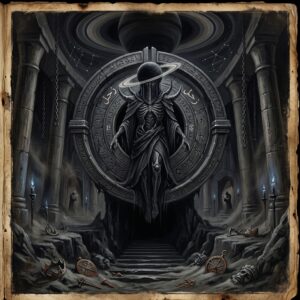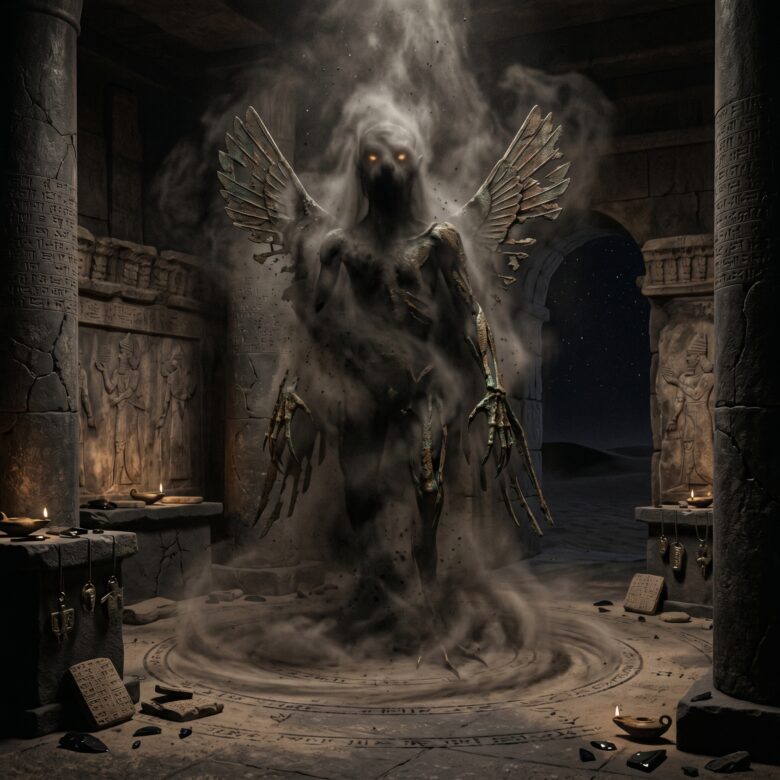
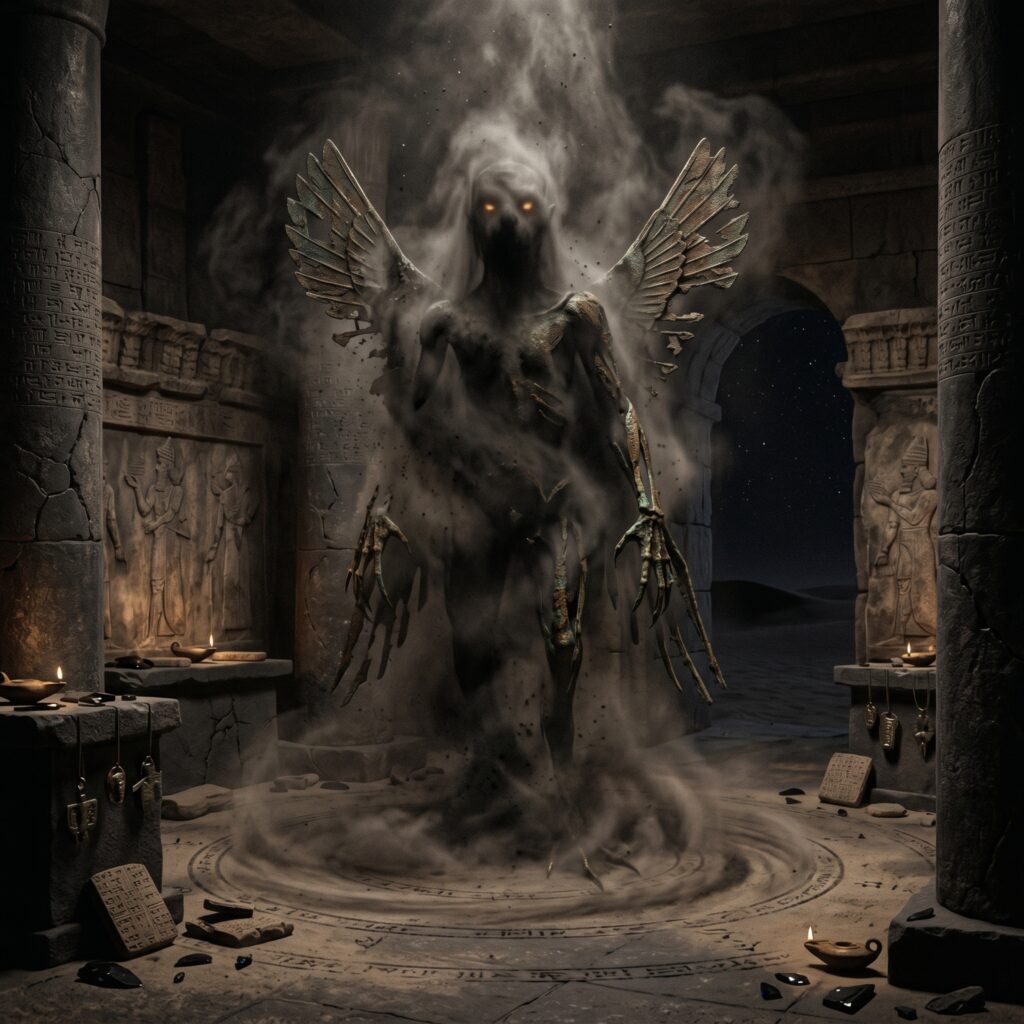
You don’t worship Pazuzu. You don’t offer him incense, pour libations, or pray for his favor. You hang his image on the wall, place his head at the threshold, and hope he does what he does.
Pazuzu is not a god. He has no temple, no priesthood, no cult. He is a wind-demon—specifically, the king of the evil wind-demons. His epithet Pazuzu šar kibsi tells you everything about his structural position: he rules the very category of being he is deployed against. He is an evil thing that repels other evil things.
He appears in Mesopotamian texts from the Old Babylonian through Neo-Assyrian periods, roughly 1800 to 600 BCE. His variants include Pazuza (transliteration) and his temple-derived epithet. His primary operational context is the household threshold, the birthing room, the external wall. He is not institutional. He is deployed.
His terrifying appearance—canine face, bird talons, four wings, serpent-headed penis on the bronze plaques—is not decorative. It is the mechanism of protection.
Nature & Behavior
Pazuzu is positionally conditional. His behavior changes entirely depending on where you put him.
Unconstrained (no image, no threshold positioning): He causes harm. South winds, locust swarms, fever, scorching heat, sandstorms. He is the evil wind-demon his epithet describes.
Positioned at a threshold (image facing outward): He protects. Lamashtu sees him and goes elsewhere. The vulnerable space—birth house, home, room with a new mother—is defended.
In later incantation bowls: He appears as a neutral or constrained figure, partially suppressed but still recognizable.
Same entity. Same capacities. Different output based on position and recognition. This is not a contradiction. It is a design feature.
His primary operational relationship is with Lamashtu, the infanticidal demon who targets pregnant women, new mothers, and infants. Lamashtu ignores standard protections. She comes through windows. No god stops her. No other demon restrains her.
Except Pazuzu.
The incantation texts are explicit: Pazuzu is the only entity who can confront Lamashtu effectively. Not through superior power in an abstract sense, but through structural opposition. She moves through openings; he guards thresholds. She attacks silently; he announces himself with sandstorms and fever. She terrorizes the vulnerable; he terrorizes everything indiscriminately.
The operation is not exorcism. It is recognition and positioning. His image faces the threat direction. Incantations name him as the one Lamashtu fears. Chaos recognizing chaos. Presence as protection.
Contact & Ritual Approaches
Pazuzu has no cult, no offerings, no priesthood. Engagement is exclusively apotropaic and object-based.
Attested methods:
- Amuletic display: Bronze or clay head pendants worn or hung
- Statue placement: Full or partial figurines placed in domestic thresholds
- Incantation recitation: Specific Pazuzu-against-Lamashtu texts
- Gestural action: Raising the image toward the threat direction
No offerings. No prayers in the worship sense. No priests required. The engagement is positional and silent—presence of his image is the operation. Vocal incantation contextualizes but does not function as a summoning.
Invocation / address patterns:
Pazuzu is not invoked in the standard sense of calling an entity into presence. The incantation texts name him as part of the apotropaic operation.
Attested address fragments (from incantation texts against Lamashtu):
“Pazuzu, king of the evil wind-demons”
“The fierce one, the powerful one”
No formula commands Pazuzu to act. The structure is recognition and positioning, not command or petition.
What does not exist:
- Any formula for summoning Pazuzu to presence
- Offerings or devotional acts
- Temple cult or priesthood
- Use of Pazuzu for offensive operations (cursing, binding, attacking)
Working With the Entity
You don’t “work with” Pazuzu in the sense of relationship, alliance, or invocation. You deploy him.
Attested practitioner modes:
- Household protection: The head of the household places Pazuzu images at doorways, windows, and birth houses. No ritual training required. The operation is object-based.
- Birthing protection: Attendants place Pazuzu amulets in rooms where birth occurs or where a new mother rests. The threat window is the postpartum period.
- Exorcistic support: In more complex cases, trained āšipu might recite the longer Pazuzu-against-Lamashtu incantations while deploying the image.
Practical effects traditionally associated:
- Lamashtu deterred from entering the protected space
- Reduced incidence of unexplained infant death and maternal fever
- Contained anxiety around domestic vulnerability
No relationship with the entity is required or documented. The operation works or it does not. The practitioner does not receive feedback, guidance, or initiation from Pazuzu.
Modern sovereignty / adversarial framing (not attested historically):
Some contemporary practitioners approach Pazuzu as a figure of redirected chaos—a model for using one’s own destructive capacity as a protective boundary. This is not found in the sources. It is modern application using Pazuzu as a symbolic template.
Reported effects from this modern frame:
- Increased capacity to deploy aggressive boundary enforcement
- Reduced hesitation in confronting intrusive forces
- Integration of one’s own “shadow” capacities as protective tools
Practitioners using this frame should know they are applying symbolic logic, not recovering historical practice.
Stability, Risk, and Failure Modes
What stabilizes apotropaic work (attested):
- Correct placement of images (thresholds, doorways, birth houses—facing outward toward the threat)
- Correctly identified Pazuzu image (canine face, wings, raised hand—the iconographic markers)
- Proper orientation (image facing the direction Lamashtu is expected to approach from)
What destabilizes it:
- Placement at incorrect orientation (image facing inward rather than outward)
- Removal of image without replacement
- Attempting to invoke Pazuzu for offensive purposes (not attested; structural logic unclear)
For modern sovereignty work (practitioner reports, not traditional):
- Clear intent and target needed (undirected aggression may produce undirected effects)
- Integration with grounding practices to prevent boundary confusion
- Not recommended for practitioners who cannot distinguish between protective aggression and uncontrolled hostility
Cross-Tradition Differences
| Tradition | Type | Interaction Mode |
|---|---|---|
| Old Babylonian | Incipient wind-demon | Not yet fully individuated |
| Neo-Assyrian | Individuated apotropaic entity | Amuletic display + incantation |
| Jewish-Aramaic bowls | Syncretic demon figure | Written on bowls for protection |
Transmission arc: Wind-demon → apotropaic protector → incantation bowl entity → suppressed in late Zoroastrian-influenced periods. No continuity into European grimoire traditions.
Functional equivalents elsewhere (structural, not genealogical):
- Lamashtu (antagonist-counterpart—structurally paired, not equivalent)
- Humbaba (earlier Mesopotamian monstrous guardian—different functional role)
- Tibetan srung ma (terrify lesser spirits—functional parallelism)
The comparative value is structural. Multiple systems arrived at the same solution: chaos can discipline chaos.
Long-Term Practitioner Effects
For traditional apotropaic use (attested): No documented long-term effects on the practitioner. The operation is discrete and object-based. The practitioner does not develop a relationship with Pazuzu. Protection is either present or absent.
Households that maintain Pazuzu images at thresholds do so as a consistent practice. The effect is architectural and symbolic—the protected space remains protected. No transformation of the practitioner is reported.
For modern symbolic use (practitioner reports, not traditional):
- Increased comfort with deploying destructive energy as a boundary
- Reduced moral hesitation around aggressive protection
- Potential for boundary confusion if the distinction between protection and aggression blurs
These effects are reported by practitioners using Pazuzu as a symbolic template for sovereignty work. The dossier presents them as observed patterns, not traditional claims.
Practitioner Notes
Who works well with Pazuzu (apotropaic mode, attested):
- Household heads, birth attendants, anyone responsible for a threshold
- No special training or temperament required—the operation is object-based
- Best suited for those who understand the logic of “chaos repels chaos” without needing to moralize it
Who works well with Pazuzu (modern symbolic mode, not attested):
- Practitioners comfortable with wrathful or adversarial framing
- Those who can deploy aggressive boundary enforcement without losing control
- Individuals with existing stability in confronting their own destructive capacities
Who should avoid:
- Anyone seeking relationship, alliance, or worship (not the function)
- Practitioners who need entities to be morally pure or benevolent
- Those uncomfortable with terrifying imagery as protective mechanism
Solo vs institutional: Historically domestic, not institutional. Modern practitioners can work solo with Pazuzu easily—the operation is simple and object-based.
Compatibility with other systems:
- Works within Mesopotamian apotropaic framework (paired with Lamashtu)
- The logic of “chaos repels chaos” may conflict with order-based protection systems (angels, purified spirits, divine guardians)
- No direct compatibility or conflict with most modern systems—Pazuzu is domain-specific (thresholds, Lamashtu, birth protection)
- Using Pazuzu outside that domain (general protection, cursing, knowledge work) is not attested
The bottom line: Pazuzu is not a spirit to be befriended, commanded, or worshipped. He is a tool. A terrifying, chaos-bearing tool placed at the gate because Lamashtu fears him. Treating him as a partner or a deity is not attested and may produce a different operational dynamic than the one documented in the sources.
You don’t call on him. You place him at the threshold. You face him outward. You trust that chaos, correctly positioned, knows the difference between inside and outside.
For a thousand years in Mesopotamia, that trust was not misplaced.