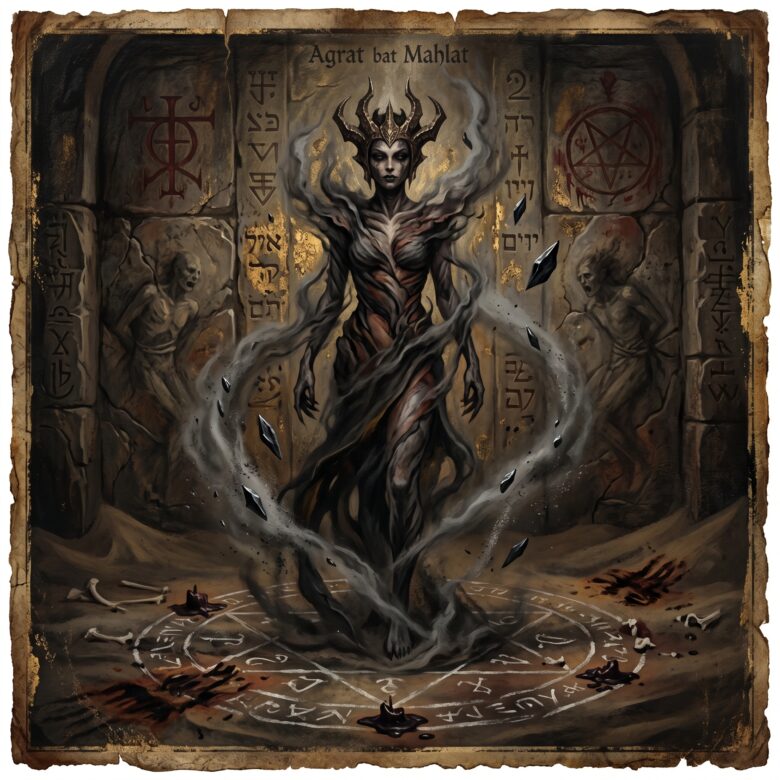
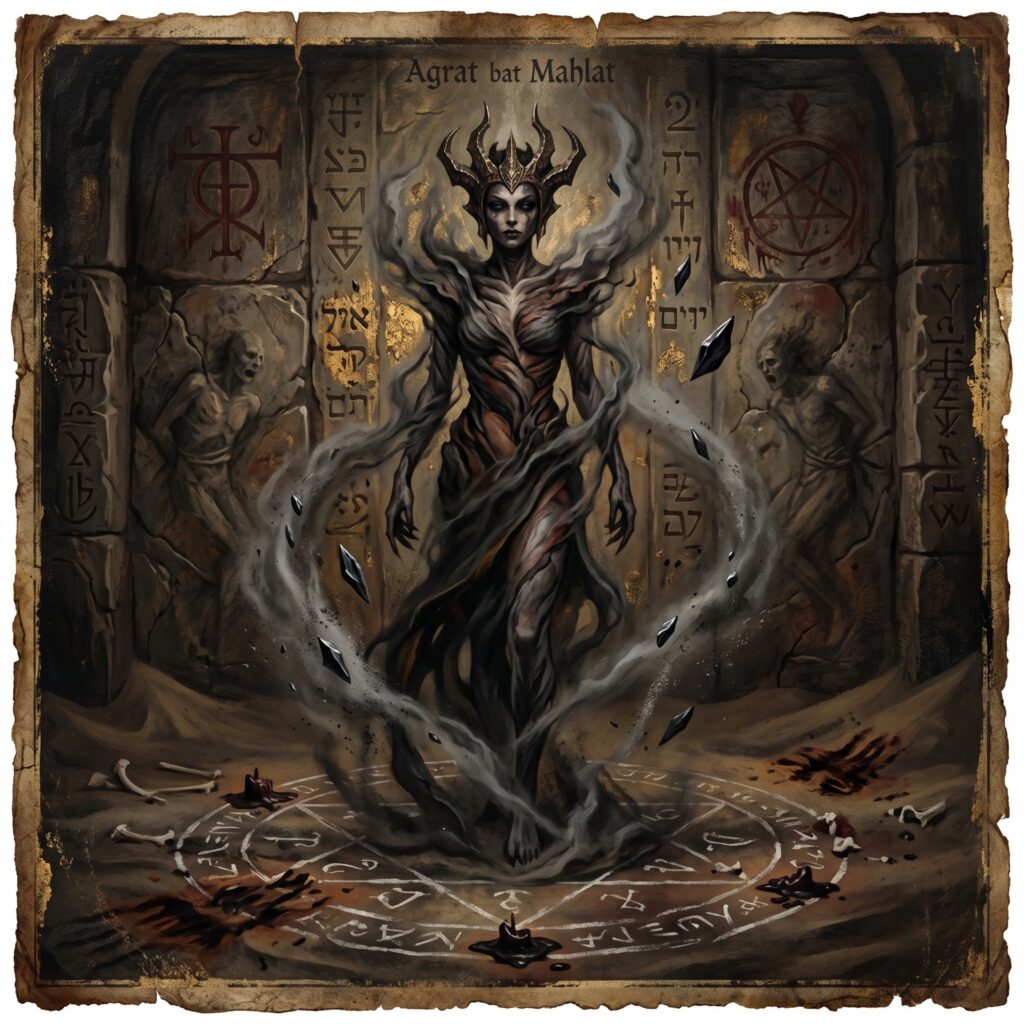
Agrat bat Mahlat hunts between midnight and the fifth hour of the night. That is her time, her domain, her hunting ground. If you are walking alone in those hours—on a deserted road, through an empty courtyard, across the threshold of sleep, through any unlit liminal space—you are in the territory of Agrat bat Mahlat.
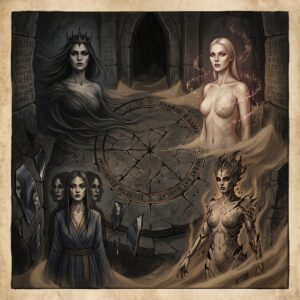
She is one of the four Queens of Demons in classical Jewish demonology, standing alongside Lilith, Naamah, and Eisheth Zenunim. These four Queens of Demons represent the primary female powers of the sitra achra—the “other side,” the shadow realm of impurity and chaos that opposes and balances the divine order. Agrat bat Mahlat is the second of these four Queens of Demons in most hierarchies, subordinate only to Lilith herself.
She is the daughter of Mahlat—named not for her father (which would be the norm) but for her mother. That matronymic is unusual in Jewish demonology and signals something important about her lineage. Mahlat means “dance” or “whirl.” Agrat bat Mahlat’s own name carries the same connotation: whirling, dancing, the frenzied motion of the night wind, the spinning disorientation that leads travelers astray.
Agrat bat Mahlat is not worshipped. She is not invoked in traditional Judaism. She is a predator, one of the four Queens of Demons who hunts the living. She is the reason the Talmud says not to walk alone after midnight. Understanding Agrat bat Mahlat means understanding the Jewish demonological encoding of nocturnal anxiety, sexual vulnerability, and the chaos that prowls when order sleeps.
Nature & Behavior of Agrat bat Mahlat
Agrat bat Mahlat is a nocturnal threat entity, one of the four Queens of Demons who dominates the liminal hours. Her primary function is hunting men who walk alone at night. The Babylonian Talmud (Pesachim 111b) is explicit and chilling: between midnight and the fifth hour of the night, Agrat bat Mahlat and 180,000 destroying angels roam the earth. Anyone who walks alone in that window places themselves in danger of encountering Agrat bat Mahlat and her destructive host.
But Agrat bat Mahlat is not just a hunter. In Kabbalistic tradition, she becomes a succubus—one of the four Queens of Demons who draws seed from sleeping men, mothers demons by Samael (the archangel of death and poison) or by Asmodeus, and participates in the procreation of the demonic realm. Alongside Lilith, Naamah, and Eisheth Zenunim, Agrat bat Mahlat is one of the Queens of Demons who take what men spill in unconsciousness and create the sitra achra—the shadow population of the demonic world.
Agrat bat Mahlat also sings. This is one of her most surprising attributes. Perek Shirah (“Chapter of Song”), a mystical Jewish text attributing songs to every element of creation, places Agrat bat Mahlat’s shirah (song) after midnight. Even Agrat bat Mahlat, the whirling queen of the demonic sitra achra, praises the divine. That is the paradox of the four Queens of Demons: chaos has its place in order. The dark has its voice in the choir of creation. Agrat bat Mahlat dances and sings in the hours when most of humanity sleeps.
Her behavior as one of the four Queens of Demons is predatory but not personal. Agrat bat Mahlat does not target individuals out of malice in the traditional accounts. She hunts because hunting is what Agrat bat Mahlat does. She is a force, not a grudge. The danger is her presence, not her vendetta. Avoid her hours. Avoid her empty roads. That is the protection. That is the traditional relationship with Agrat bat Mahlat.
In modern demonolatry, some practitioners approach Agrat bat Mahlat as a Queen of Demons for sovereignty work, sexual magic, or shadow exploration. They treat her as one of the four Queens of Demons worth invoking rather than avoiding. This is reconstruction. The traditional Jewish sources do not support invocation of Agrat bat Mahlat. She is not a spirit you call. She is a spirit you avoid, one of the four Queens of Demons you protect yourself against.
Contact & Ritual Approaches for Agrat bat Mahlat
There is no traditional ritual for contacting Agrat bat Mahlat. None. The Talmudic and later Jewish sources are unanimous: Agrat bat Mahlat is a danger to be avoided, not an entity to be engaged. She is one of the four Queens of Demons, and the four Queens of Demons are not invoked in normative practice.
Traditional approach to Agrat bat Mahlat (apotropaic, not invocatory):
- Do not walk alone between midnight and the fifth hour of the night (approximately midnight to 3–5 a.m., depending on season). This is the time of Agrat bat Mahlat.
- Use protective measures: amulets, mezuzah on doorposts, recitation of specific verses (Psalm 91, the Shema, etc.). These protect against Agrat bat Mahlat and the 180,000 destroying angels that accompany her.
- Stay indoors during the hours of Agrat bat Mahlat. Stay in company. Light a candle. The Talmud mentions that a dog’s bark or a donkey’s bray can alert you to demonic presence, but the best protection against Agrat bat Mahlat is not being outside at all.
Modern demonolatry approach to Agrat bat Mahlat (reconstruction, not traditional):
- Some practitioners invoke Agrat bat Mahlat as one of the four Queens of Demons, using sigils (modern creations, not historical), enns (modern chant formulas), and offerings (dark wine, incense, midnight candles).
- Timing: her hour (after midnight) is used for the working. Invoking Agrat bat Mahlat at her peak hour is considered more effective.
- Intent: sovereignty work (claiming authority over the night, over one’s own sleep, over fear of the dark), sexual magic (conscious succubus work with Agrat bat Mahlat, dream incubation), shadow work (confronting fear of darkness, isolation, death, and chaos).
- Practitioners of Agrat bat Mahlat often work with all four Queens of Demons as a set, understanding that Agrat bat Mahlat represents a specific current within the demonic feminine hierarchy.
What is not attested for Agrat bat Mahlat: Any historical method for calling Agrat bat Mahlat to presence. No seal in the Goetic sense. No prayer. No offering structure in traditional Jewish sources. No synagogue, no rabbi, no blessing mentions Agrat bat Mahlat as a recipient of contact. If you are calling Agrat bat Mahlat, you are inventing. That does not mean the work is invalid—but it means you are operating in reconstructed territory, not transmitted tradition.
Working With Agrat bat Mahlat
Traditional Jewish practice does not “work with” Agrat bat Mahlat. You protect yourself from Agrat bat Mahlat. You avoid the hours of Agrat bat Mahlat. You recite verses that repel Agrat bat Mahlat. You do not call her.
But modern practitioners—demonolators, Left Hand Path occultists, esoteric Kabbalists, and those drawn to the four Queens of Demons—have developed frameworks for engagement with Agrat bat Mahlat. This section covers those reconstructed approaches to Agrat bat Mahlat.
Sovereignty and fear-facing work with Agrat bat Mahlat:
Practitioners work with Agrat bat Mahlat to confront fear of the dark, isolation, and nocturnal vulnerability. As one of the four Queens of Demons, Agrat bat Mahlat represents the specific terror of the lone walker, the traveler without protection, the person exposed in liminal space. Her whirling, dancing energy is disorienting—intentionally so. Working with Agrat bat Mahlat means learning to stand still in the whirl.
Methods for sovereignty work with Agrat bat Mahlat:
- Walking alone at night (contra the traditional prohibition) as an ordeal dedicated to Agrat bat Mahlat
- Meditating on her name and her hour (midnight to 3 a.m.)
- Claiming authority over the space between midnight and dawn in the name of Agrat bat Mahlat
- Creating a sigil for Agrat bat Mahlat (modern) and charging it at midnight
Effects reported from sustained work with Agrat bat Mahlat:
- Reduced nighttime anxiety. The dark becomes familiar, not threatening.
- Increased comfort with solitude. Agrat bat Mahlat hunts the lone walker, but walking with her means never walking alone.
- Ability to navigate liminal spaces (physical and psychological) without panic or disorientation
- A sense of partnership with the night rather than fear of it—Agrat bat Mahlat as ally, not predator
Sexual and succubus work with Agrat bat Mahlat:
Agrat bat Mahlat draws seed. She is a succubus, one of the four Queens of Demons who harvests male generative fluid for the production of demonic offspring. In traditional Kabbalah, this is negative—wasted potential, death of souls, pollution. In modern practice with Agrat bat Mahlat, some practitioners engage her consciously for:
- Dream incubation of sexual encounters (succubus visitation as conscious practice, inviting Agrat bat Mahlat into the dream space)
- Harvesting of sexual energy for magical purposes (drawing seed as offering to Agrat bat Mahlat, recycling that energy into spellwork)
- Exploration of nocturnal emission as a spiritual event, not a shameful one—working with Agrat bat Mahlat to reclaim the night body
Effects reported from sexual work with Agrat bat Mahlat:
- Intensified dream life, particularly sexual or boundary-testing dreams featuring Agrat bat Mahlat or other Queens of Demons
- Release of shame around nocturnal sexuality and spontaneous emission
- Increased sexual energy in waking life (Agrat bat Mahlat’s succubus current activates the practitioner)
- Risk: obsession, boundary confusion, difficulty distinguishing dream contact with Agrat bat Mahlat from waking reality
Shadow work and the lineage of the four Queens of Demons:
Agrat bat Mahlat is one of four. Working with her often means working with Lilith, Naamah, and Eisheth Zenunim as a set. The four Queens of Demons represent different aspects of the demonic feminine: Lilith (primary queen, mother of demons, killer of infants), Naamah (seducer, singer, mother of demons), Agrat bat Mahlat (midnight hunter, whirling dancer, succubus), and Eisheth Zenunim (woman of whoredom, promiscuity, sexual chaos).
Practitioners working with Agrat bat Mahlat as part of the four Queens of Demons explore:
- Matrilineal demonic power—Agrat bat Mahlat is named for her mother (Mahlat), not her father. This is rare and significant. The four Queens of Demons operate through maternal lines, not paternal.
- Whirling and dancing as a spiritual technology—trance, ecstatic movement, loss of orientation as gnosis. Agrat bat Mahlat’s name encodes this technology.
- The sitra achra as a necessary counterforce to divine order. Agrat bat Mahlat and the other Queens of Demons are not evil in the dualistic sense; they are the shadow without which light has no definition.
Effects reported from shadow work with Agrat bat Mahlat and the four Queens of Demons:
- Integration of shadow material related to sexuality, death, chaos, and the night
- Increased capacity for ecstatic or trance states (whirling, dancing, spinning as spiritual practice)
- Rejection of purity-based spiritual frameworks that demonize the dark
- Risk: destabilization of conventional identity, difficulty reintegrating into normative religious or social structures that condemn the four Queens of Demons
Stability, Risk, and Failure Modes When Working With Agrat bat Mahlat
What helps stabilize engagement with Agrat bat Mahlat (modern work):
- Clear intent. Agrat bat Mahlat is not a spirit for casual exploration. Know why you are calling her.
- Grounding practices after working with Agrat bat Mahlat. Her energy is expansive, disorienting, nocturnal. Come back to the body. Come back to daylight.
- Community support (if available). Night work with Agrat bat Mahlat can be isolating.
- Boundary management. Succubus work with Agrat bat Mahlat especially requires clear differentiation between contact and obsession, between dream and waking.
What destabilizes engagement with Agrat bat Mahlat:
- Walking alone at night without protection (traditional prohibition—verified by practitioners of Agrat bat Mahlat who learned the hard way)
- Unresolved sleep disorders or trauma around darkness and isolation (Agrat bat Mahlat will amplify)
- Sexual shame or unresolved abuse history (succubus work with Agrat bat Mahlat may amplify without proper healing)
- Overidentification with the whirling and dancing energy of Agrat bat Mahlat (loss of orientation, difficulty returning to daily life)
- Mixing traditional fear-framing of Agrat bat Mahlat with modern invocation (cognitive dissonance destabilizes the work)
Failure modes with Agrat bat Mahlat:
- Traditional: you walk alone at night during her hour. Nothing happens—or something does. The Talmud warns that the danger of Agrat bat Mahlat is real but not guaranteed. Some nights she hunts, some nights she does not. The prohibition is precautionary, but experienced practitioners of Agrat bat Mahlat report that repeated exposure increases the likelihood of encounter.
- Modern: you invoke Agrat bat Mahlat and experience nothing. No contact. No dream. No shift. This is common. Agrat bat Mahlat’s presence is subtle—she does not appear as a cinematic figure. Some practitioners report needing dozens of invocations before any sign of Agrat bat Mahlat manifests.
- Negative outcomes: sleep paralysis, nightmares, intrusive sexual imagery, persistent anxiety about darkness, difficulty sleeping alone. Some practitioners report these as side effects of poorly bounded work with Agrat bat Mahlat.
Cross-Tradition Differences for Agrat bat Mahlat
| Source/Tradition | Name | Role of Agrat bat Mahlat | Interaction with Agrat bat Mahlat | Notes |
|---|---|---|---|---|
| Talmud (Pesachim 111b) | Agrat bat Mahlat | Night demon, hunter of lone men | Avoidance, protection | No invocation of Agrat bat Mahlat |
| Perek Shirah | Agrat bat Mahlat | Sings shirah after midnight | Contemplation (her song) | Agrat bat Mahlat praises the divine |
| Zohar / Kabbalah | Agrat bat Mahlat | Succubus, Queen of Demons, consort of Samael | Esoteric (not normative) | Agrat bat Mahlat as seed-drawer |
| Modern demonolatry | Agrat bat Mahlat | Queen of Demons | Invocation, devotion | Reconstruction of Agrat bat Mahlat practice |
What remains consistent for Agrat bat Mahlat: Name (Agrat bat Mahlat). Matronymic (daughter of Mahlat). Association with night, midnight, and the liminal hours. Position among the four Queens of Demons.
What changes for Agrat bat Mahlat: Sexual function (absent in Talmud, present in Kabbalah). Invocability (none in tradition, present in modern practice). Song (Perek Shirah is a unique addition not present in other sources about Agrat bat Mahlat).
Long-Term Practitioner Effects of Working With Agrat bat Mahlat
Practitioners who work with Agrat bat Mahlat consistently (modern context, not traditional) report patterns.
Positive effects from Agrat bat Mahlat work:
- Comfort with darkness. Literal and metaphorical. The night becomes a time of power, not fear. Agrat bat Mahlat teaches that darkness is not empty.
- Sovereignty over sleep. Less night terror, less paralysis, more lucid dream control. Agrat bat Mahlat rules the threshold of sleep; working with her grants authority over that threshold.
- Integration of the “whirling” energy of Agrat bat Mahlat. The practitioner learns to access disorientation as a gnostic tool—trance, ecstatic dance, spinning meditation as contact with Agrat bat Mahlat.
- Release of shame around nocturnal sexuality. Agrat bat Mahlat normalizes what happens in sleep.
Mixed effects from Agrat bat Mahlat work:
- Social isolation. Night work with Agrat bat Mahlat is solitary. Her hours are not shared with most people. Friends may not understand.
- Difficulty with conventional spiritual frameworks. Purity-based systems (normative Judaism, Christianity, Islam) have no place for Agrat bat Mahlat.
- Boundary blurring. The line between dream contact with Agrat bat Mahlat and waking contact can thin. Some practitioners report sensing Agrat bat Mahlat during the day after sustained night work.
Negative effects from Agrat bat Mahlat work:
- Persistent sleep disruption. The practitioner may become too attuned to midnight, unable to sleep through the night, always alert for Agrat bat Mahlat.
- Intrusive sexual imagery. Succubus work with Agrat bat Mahlat without proper boundaries can become obsessive, flooding waking consciousness.
- Fear of abandonment. Agrat bat Mahlat is not a nurturing presence. She is a queen. She does not comfort. Practitioners seeking maternal care from Agrat bat Mahlat will be disappointed.
Practitioner Notes for Working With Agrat bat Mahlat
Who works well with Agrat bat Mahlat:
- Night people. Those who are already awake after midnight, naturally alert in the dark hours. Agrat bat Mahlat calls to the owls.
- Practitioners with stable sleep hygiene (or willingness to develop it). Agrat bat Mahlat work requires sleep discipline.
- Those comfortable with predatory or adversarial spiritual frameworks. Agrat bat Mahlat is not nurturing. She hunts.
- Sovereignty-oriented occultists who want to claim the night as their own. Agrat bat Mahlat grants authority over her hours.
- Shadow workers with experience in death, sexuality, and chaos. Agrat bat Mahlat is not a beginner entity.
Who should avoid working with Agrat bat Mahlat:
- Anyone with unresolved sleep trauma or night terror disorder. Agrat bat Mahlat will find those wounds.
- Practitioners seeking maternal comfort or gentle guidance. Agrat bat Mahlat is the wrong entity for that need.
- Those who need their spiritual practice to be morally pure or light-aligned. Agrat bat Mahlat is one of the four Queens of Demons. Darkness is her domain.
- Beginners. Agrat bat Mahlat is not a starter spirit. Work with Lilith first if you must approach the Queens of Demons.
Solo vs institutional: Solitary. There is no temple, no priesthood, no congregation for Agrat bat Mahlat. Her work is done alone, in the dark, in the hours when others sleep. This is non-negotiable.
Compatibility of Agrat bat Mahlat with other systems:
- Incompatible with normative Judaism (Agrat bat Mahlat is a demon to be avoided, not engaged).
- Compatible with modern demonolatry and Left Hand Path systems.
- Compatible with dark goddess traditions (functionally similar to Lilith, Hecate, Kali—Agrat bat Mahlat fits this archetype).
- Incompatible with purity-based or light-only spiritual frameworks.
The bottom line on Agrat bat Mahlat: Agrat bat Mahlat is the whirling queen of midnight. She hunts the lone walker. She dances in the dark. She sings praise after midnight. She draws seed and mothers demons. She is one of the four Queens of Demons, second only to Lilith. In traditional Judaism, Agrat bat Mahlat is a danger—avoid her hours, stay indoors, protect yourself. In modern demonolatry, Agrat bat Mahlat is a Queen of Demons, approached for sovereignty, sexual magic, and shadow work. She is not kind. She is not gentle. Agrat bat Mahlat is the night wind that twists the road and disorients the traveler.
If you walk alone after midnight, listen for the dance of Agrat bat Mahlat. She may be closer than you think.