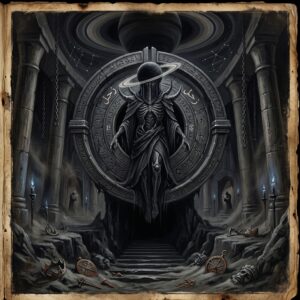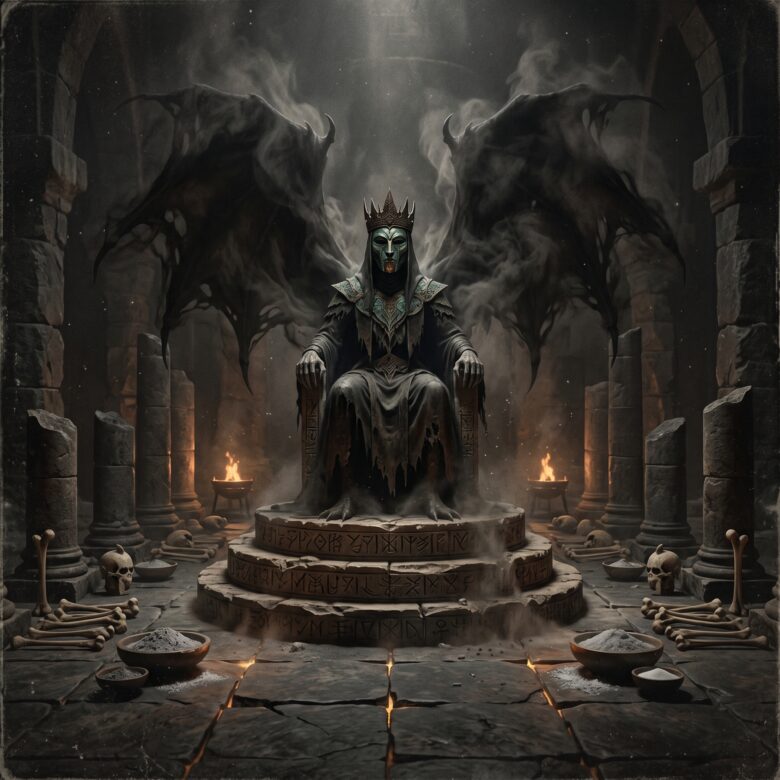
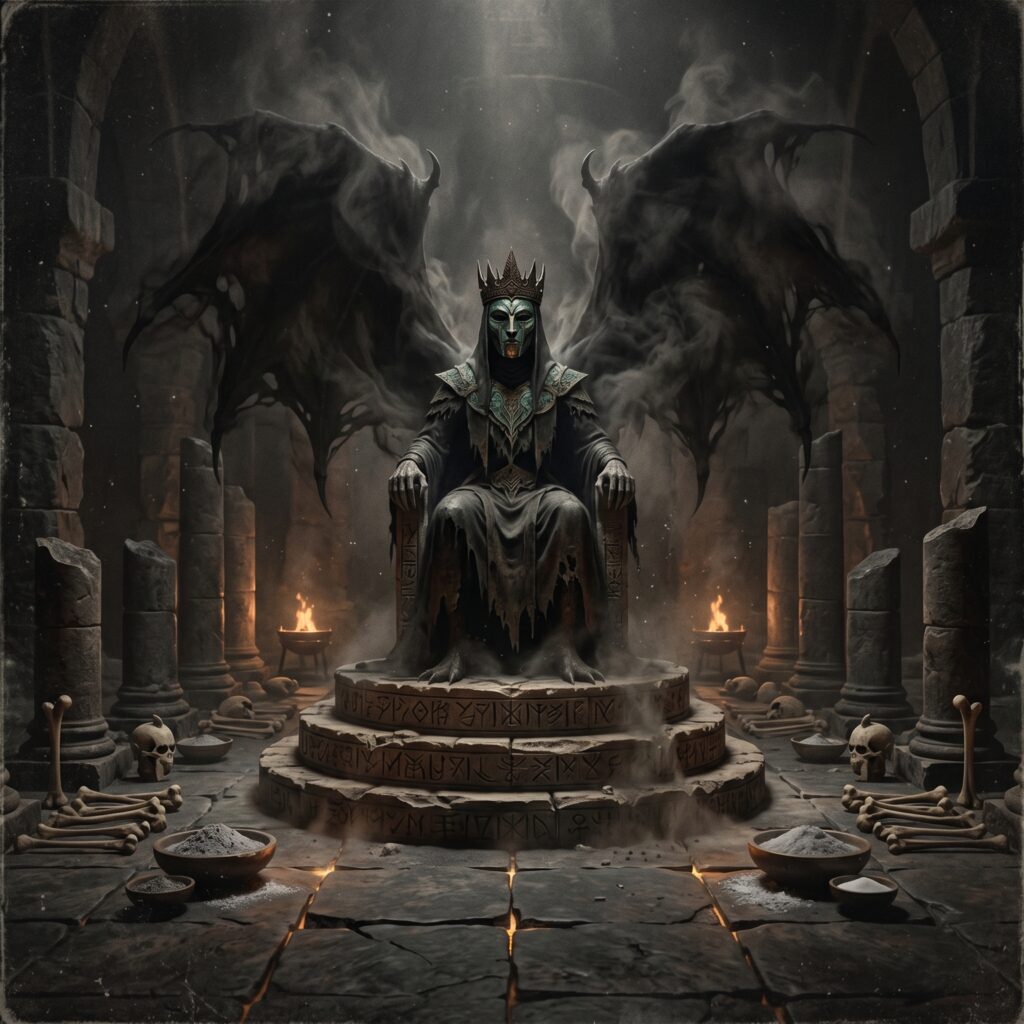
Bune is the 26th spirit of the Ars Goetia, and he is unusual. Most Goetic spirits specialize. Bune does not. He handles wealth, eloquence, wisdom, and the authority to raise the dead. That is a rare combination.
He appears as a three-headed dragon. The first head is like a Dog. The second is like a Griffin. The third is like a Man. He speaks with a high, still voice—Lunea, the old texts call it. Soft. Quiet. You have to listen carefully.
His rank varies across manuscripts. Sometimes a Duke. Sometimes a Grand Duke. Sometimes a King. He commands 30 legions of spirits. His gender also varies: Johann Weyer’s Pseudomonarchia Daemonum calls him a female (“she,” “her”). The Ars Goetia uses male pronouns. Modern practitioners often treat Bune as gender-neutral or fluid. The dragon does not care about your pronouns. He—she—they—will work with you if you approach correctly.
Bune appears in multiple grimoires: the Livre des Esperitz (15th century), Pseudomonarchia Daemonum (1577), the Ars Goetia (17th century), and Sloane MS 3824. His functions are remarkably stable across four centuries of transmission. The core triad—wealth, eloquence, death authority—never changes.
Nature & Behavior
Bune behaves like a quiet authority. Not loud like Paimon’s trumpets. Not roaring like the harsh commanding voices of other Goetic spirits. Bune speaks softly, and you must lean in to hear.
He is not wrathful. He is not deceptive. The grimoires do not warn of tricks or malice. He bestows wealth, makes you eloquent and wise, answers questions about treasure and hidden goods, changes the location of treasure, and—most notably—causes those who have died to return.
This last function is key. The phrase “causes the dead to return” is not resurrection in the Christian sense. Bune does not raise corpses to walk the earth. He retrieves spirits. He gives the practitioner authority to contact the dead, to summon them for questioning, to negotiate with the afterlife boundary. In modern terms, he is a necromantic spirit—but not a dark one. He is a facilitator, not a horror figure.
The three heads encode his three domains:
- Dog head: cunning, alertness, guardian of treasure. The Dog finds and protects wealth.
- Griffin head: chthonic power, guardian of buried gold, creature of the underworld. The Griffin rules the boundary between earth and the realm of the dead.
- Man head: wisdom, eloquence, speech. The Man speaks. The Man teaches.
Bune responds to respectful, clear requests. He does not require the dramatic coercive commands that some Goetic spirits demand. His high, still voice is a clue: the practitioner must be quiet, attentive, receptive. Loud, aggressive summoning may not work with him.
Contact & Ritual Approaches
Bune is a Goetic spirit, so the traditional framework is Solomonic evocation: the circle, the triangle, the brass vessel, the divine names, the seal. That is the standard method.
Specific to Bune:
- Timing: Some practitioners use planetary hours. Saturn for necromantic authority (death domain). Jupiter for wealth and expansion. The grimoires themselves do not specify, but the functions suggest the planets.
- Orientation: Not specified in Goetia. Some practitioners place his seal in the East or West; follow your instinct or system.
- Offerings: Not required in the Goetic frame (unlike Paimon’s sacrifice). However, many modern practitioners offer incense, candles, or small treasures (coins, jewelry) as a gesture of respect.
- Listening: The key to Bune is listening. His voice is high and still. If you are rushing, distracted, or noisy, you may miss the contact entirely.
The evocation experience: Practitioners report that Bune appears as a massive, still dragon coiled in darkness. The three heads are visible. The Dog head may sniff or growl. The Griffin head watches silently. The Man head speaks. The voice is soft, almost like a whisper or a thought. You must quiet your mind to hear.
Modern approaches (demonolatry, independent practice): Practitioners who work devotionally may light candles (gold for wealth, black for necromancy, white for wisdom), chant Bune’s enn, meditate on his seal, and invite rather than command. This is not the historical method, but it works for many.
What does not work: Loud, aggressive, commanding evocations with no listening component. Treating Bune as a slave or a trivial wish-granter. Disrespecting the dead (if working the necromantic function). Expecting overnight millions without effort.
Working With the Entity
Bune supports three primary working modes. You can focus on one or integrate them.
Wealth work (most common, lowest risk): Bune bestows riches, changes the location of treasure, answers questions about hidden goods. Practitioners report unexpected financial opportunities, inheritances, business deals that close favorably, and a general sense of abundance. The wealth tends to arrive through mundane channels—promotions, investments, lucky breaks—not literal chests of gold.
Practical effects:
- Increased financial flow without obvious source
- Opportunities to acquire valuable goods or property
- Business acumen and strategic thinking about wealth
- Reduced anxiety about money
Eloquence and wisdom work (moderate risk, high reward): Bune makes men eloquent and wise. He teaches the arts of speech, rhetoric, and decision-making. Practitioners report:
- Speaking more clearly and persuasively
- Writing with greater fluency
- Making better decisions with less hesitation
- Being perceived as wiser by peers and superiors
- Natural authority in professional settings
This function works well for public speakers, writers, leaders, and anyone whose profession requires communication.
Necromantic work (highest risk, requires experience): Bune causes the dead to return. This is not for beginners. He facilitates contact with the deceased—ancestors, historical figures, spirits who have passed. Practitioners report:
- Clear communication with specific deceased individuals
- Retrieval of forgotten or hidden knowledge from the dead
- Ancestral healing and lineage work
- Closure with unresolved death-related grief
Critical advisory on necromancy: Do not approach this function casually. The dead are not playthings. Bune will assist, but you must have clear intent, proper respect, and a stable psychological container. Unresolved grief, trauma, or attachment to the deceased can destabilize the work. Some practitioners recommend separate rituals for wealth/eloquence and necromancy—do not mix them unless you know what you are doing.
Combined effects (practitioners who work all three domains): The wealth, eloquence, and death authority build on each other. The practitioner becomes materially secure, verbally powerful, and unafraid of death. This is a sovereignty combination: you control your resources, your speech, and your relationship to mortality. Few other Goetic spirits offer this triad.
Stability, Risk, and Failure Modes
What helps stabilize engagement:
- Quiet, focused environment (his voice is soft)
- Regular schedule (consistent evocation or meditation builds relationship)
- Clear intent per session (wealth, eloquence, or necromancy—do not mix all three at once without experience)
- Offerings if you feel led to give them (incense, candles, coins, written gratitude)
- Grounding after contact (Bune’s energy is expansive and can leave you scattered)
What destabilizes engagement:
- Loud, aggressive ritual style (he will not respond)
- Greed or obsession with wealth (the energy can amplify material fixation)
- Unresolved death-related trauma (for necromantic work)
- Inconsistent practice (summoning once, ignoring for months, then demanding results)
- Mixing incompatible frameworks (Solomonic coercion with devotional expectations)
Failure modes:
- The evocation simply does not work. No contact. No results. Check your silence, your listening, your timing.
- Wealth manifests but brings problems (unexpected expenses, taxes, envy from others). Bune gives wealth; he does not teach you how to manage it. That is your job.
- Eloquence becomes manipulation. The practitioner speaks so persuasively that they become untrustworthy. Wisdom should temper this, but not all practitioners integrate the wisdom function.
- Necromantic contact becomes intrusive. The dead do not always leave when dismissed. If you open the door, you must close it properly. Bune will help, but you are the operator.
No traditional sources describe Bune as dangerous or malicious. His risks are practical, not existential. But the necromantic function is serious. Do not treat it lightly.
Cross-Tradition Differences
| Source/Tradition | Name | Rank | Gender | Necromancy? | Wealth? | Eloquence? |
|---|---|---|---|---|---|---|
| Pseudomonarchia Daemonum (1577) | Bime | Grand Duke | Female | Yes | Yes | Yes |
| Ars Goetia (17th c.) | Bune/Bimé | Duke | Male | Yes | Yes | Yes |
| Livre des Esperitz (15th-16th c.) | Buné | Duke (implied) | Not specified | Yes | Yes | Yes |
| Sloane MS 3824 | Bime | Grand Duke | Not specified | Yes | Yes | Yes |
| Modern demonolatry | Bune | Varies | Fluid | Yes | Yes | Yes |
What remains consistent: Three-headed dragon form (Dog, Griffin, Man). Wealth bestowal. Eloquence and wisdom. Necromantic authority (raising the dead). High, still voice. 30 legions. The core functional triad never changes across five centuries of transmission.
What changes: Rank (Duke vs Grand Duke). Gender (female in Weyer, male in Goetia, fluid in modern practice). The rank variance suggests Bune’s position in the hierarchy was not standardized—some manuscripts placed him higher than others. The gender variance is unusual for Goetic spirits, most of whom are consistently gendered. Some practitioners interpret this as Bune being more adaptable or less concerned with human gender categories.
Long-Term Practitioner Effects
Practitioners who work with Bune consistently for years report patterns.
Positive:
- Genuine, sustained wealth increase. Not lottery wins—steady accumulation of resources, better opportunities, reduced financial anxiety.
- Natural eloquence that becomes effortless. The practitioner speaks well without forcing it. Wisdom comes across in everyday decisions.
- Comfort with death. The necromantic function, even if used rarely, changes the practitioner’s relationship to mortality. Less fear. More curiosity. More peace.
- Sovereignty over three domains: material, verbal, existential.
Mixed:
- Wealth requires management. Some practitioners receive abundance but lack the discipline to steward it. Bune does not teach financial literacy.
- Eloquence can become glibness. The practitioner talks their way out of accountability. Wisdom is supposed to prevent this, but not everyone integrates it.
- Necromantic contact can blur boundaries. Practitioners may become too focused on the dead at the expense of the living.
Negative (reported but less common):
- Obsessive focus on wealth to the exclusion of other life domains
- Social isolation from being “too wise” or “too wealthy” for peers
- Difficulty returning to normal after deep necromantic work (the veil feels thinner)
Bune does not produce psychological fragmentation, identity dissolution, or demonic oppression. His risks are practical and ego-related, not existential. The necromantic function is the most serious. Respect it.
Practitioner Notes
Who works well with Bune:
- Practitioners seeking genuine, sustained wealth (not quick fixes)
- Writers, speakers, teachers, leaders (eloquence and wisdom functions)
- Ancestral workers, necromancers, death-positive practitioners
- People who are quiet, patient, and good listeners (his voice is soft)
- Those who can manage wealth responsibly (or are willing to learn)
Who should avoid:
- Practitioners seeking overnight millions or lottery wins (wrong spirit)
- Loud, aggressive, coercive ritualists (he will not respond)
- Those with unresolved death-related trauma (for necromantic work)
- People who cannot listen or be still
Solo vs institutional: Goetic work is traditionally solo or small-group. Bune works well for solitary practitioners. No institutional structure required.
Compatibility with other systems:
- Works within Solomonic / Goetic framework (circle, triangle, divine names)
- Integrates with demonolatry if you invert the coercive frame
- Compatible with ancestral work and necromantic traditions (functionally)
- Conflicts with purely internal psychological models (he is treated as external in the sources)
- Wealth function aligns with prosperity magic traditions (but Bune is specific)
The bottom line: Bune is a quiet, powerful spirit who gives wealth, eloquence, and authority over death. He is not dramatic. He is not loud. He appears as a three-headed dragon and speaks in a high, still voice. Approach him with patience, clear intent, and a willingness to listen. He will teach you to be wealthy, wise, and unafraid of what comes after.
The Dog, the Griffin, and the Man. Three heads, one dragon. Sit still. Listen.