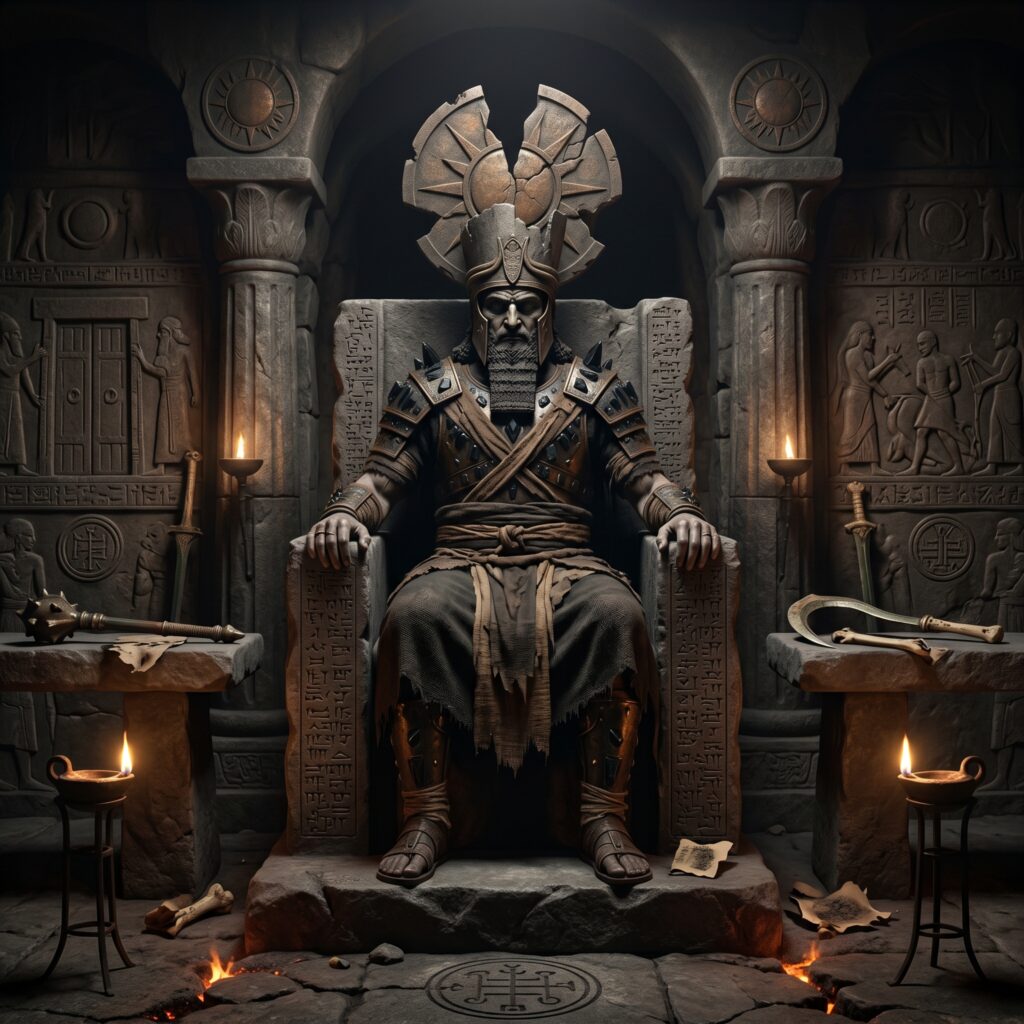
1. What This Entity Is
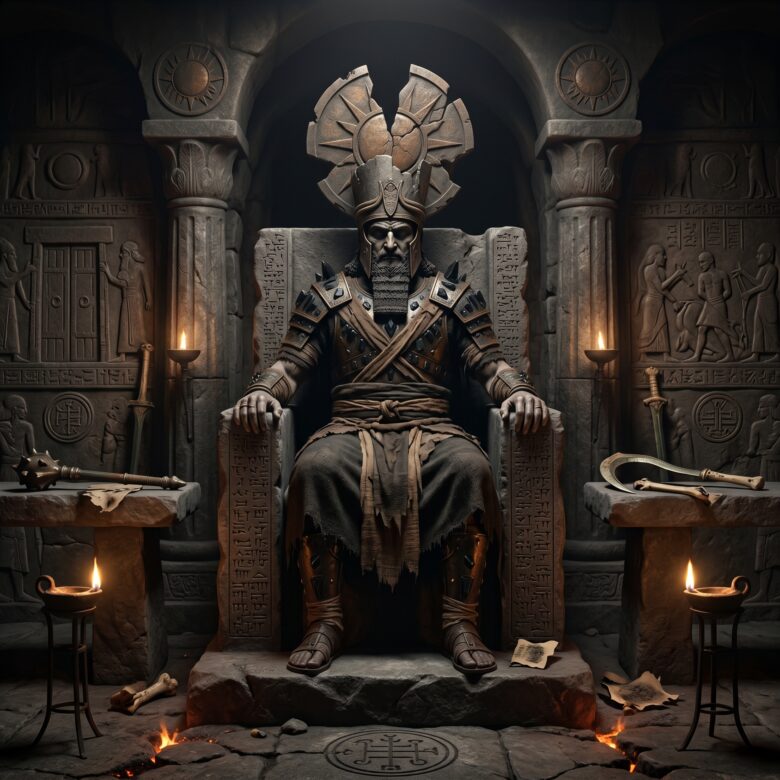
Nergal is a Mesopotamian deity of plague, war, and the underworld, attested from the Old Babylonian through Neo-Assyrian periods (circa 1800–600 BCE). He has a temple (E-Nergal in Cuthah), a priesthood, and a place in the formal pantheon. His planetary correspondence is Mars—one of the few stable astrological mappings in Mesopotamian religion.
He is not a demon. He is a god. But he is not a god you approach casually. His domains are destruction, pestilence, and death. Kings offered to him before battle not because they loved him but because they needed his destruction pointed away from themselves.
In the Nergal and Ereshkigal narrative (Akkadian period), he acquires underworld sovereignty through marriage to Ereshkigal. This transforms him from a destructive force into a ruling destructive force—co-sovereign of the land of the dead.
His Sumerian antecedents include Meslamtaea and Lugal-irra (chthonic warrior figures). His closely associated (sometimes syncretic) counterpart is Erra, a plague god with his own epic.
2. Core Behavior Pattern
Nergal behaves differently depending on context. This is not inconsistency. It is role flexibility within a single system.
| Context | Behavior |
|---|---|
| Royal inscriptions | Legitimator of conquest—the king’s victories are Nergal’s victories |
| Omen texts | Threat to be monitored—his “hand” causes plague outbreaks |
| Curse formulas | Witness and enforcer—acts upon oath-breakers with incurable fever |
| Nergal and Ereshkigal | Desiring, fearful, then dominant—acquires sovereignty through confrontation and union |
| Temple cult | Recipient of offerings, stable authority figure—appeased to prevent destruction |
In all modes, he represents legitimate destruction. Plague and war are not chaos in the Mesopotamian framework. They are divine tools that can be directed, appeased, or deployed. Nergal is the administrator of that department.
He is never defeated in standard sources. He is not a tempter, deceiver, or fallen figure. He is terrifying within the structure—not outside it.
3. Traditional Contact Methods
Nergal has a state temple cult—unlike Ereshkigal (no cult) or Pazuzu (domestic only). Engagement is primarily propitiatory and secondarily binding.
Attested methods:
- Placatory offerings (grain, animals, libations) at his temple in Cuthah—to prevent plague or war
- Curse formulas invoking his name (“May Nergal smite him with incurable fever”)
- Oath swearing—his name invoked to seal treaties and legal agreements
- Pre-battle invocation—kings seeking his destructive support (royal inscriptions)
- Incantations against plague—appealing to him to withhold his “hand”
What does not exist: Invocation to cause plague as an offensive operation. The pattern is appease to prevent, or invoke as witness/enforcer for curses. Not summon-to-deploy.
Invocation / address forms (textual layer):
Direct names used in ritual address:
- Nergal (standard)
- Meslamtaea (temple-centered address)
- Nergal šar battle (“Nergal, king of battle”—royal/military contexts)
- Erra (in plague texts)
Formulaic fragments (paraphrased from curse and incantation texts):
“Nergal, the strong one, who does not tolerate transgression”
“May Nergal, king of battle, strike him with his fierce weapon”
“Nergal of Cuthah, lord of the underworld, judge of the dead”
These are not conversational invocations. They are formulaic addresses within formal ritual or curse contexts.
4. How Practitioners Work With It
Engagement Modes
Propitiatory mode (attested, primary):
The practitioner offers to Nergal to prevent his destructive manifestations. This is temple-based, priest-mediated, often royal. The offering structure is standard Mesopotamian: grain, animals, libations. The intent is appeasement, not relationship.
Curse / binding mode (attested, secondary):
The practitioner invokes Nergal as witness and enforcer in oaths or curse formulas. The target is an enemy or oath-breaker. Nergal is not commanded. He is called to witness and expected to act against the violator. The formula is: “If X breaks this oath, may Nergal strike him with fever.”
Pre-battle mode (attested, royal context):
The king invokes Nergal’s support before military action. The expectation is that Nergal’s destructive force will be directed at the enemy, not at the king’s own forces.
What does not exist: Invocation for personal guidance, healing (outside plague cessation), protection from non-Nergal threats, or domestic devotion.
Practitioner Effects (Functional Framing)
For priests and royal practitioners working with Nergal in propitiatory contexts:
- Development of ritual precision and memory (correct offerings, correct timing)
- Understanding of plague/war patterns as interpretable through divine favor or disfavor
- Strengthened institutional authority (Nergal’s support legitimates royal action)
For curse practitioners:
- Precision in formulaic language (errors invalidate the curse)
- Understanding of oath structures and their enforceability
- No documented personal relationship with Nergal—the interaction is transactional
LHP / Wrathful Frame Note
In contemporary Left Hand Path contexts, Nergal is sometimes approached as a force of directed destruction, boundary enforcement, or sovereignty-through-confrontation. This is not attested in traditional sources but is structurally consistent with his domains (war, plague, judgment of oath-breakers). Practitioners using this frame typically report:
- Increased capacity for strategic confrontation
- Hardening of will under pressure
- Ability to enforce boundaries with consequences
The dossier notes this as modern application, not traditional transmission.
5. Conditions for Stable or Functional Work
For temple / propitiatory engagement (attested):
- Correct offerings (grain, animals, libations)
- Ritual purity (standard Mesopotamian requirements)
- Proper timing (no systematic planetary hours in sources, but festivals and specific occasions matter)
- Priest or royal mediator for high-stakes contexts
For curse / oath enforcement (attested):
- Precise formulaic language
- Named target and specific violation
- Ritual context (written curse tablet, verbal declaration in formal setting)
- No personal relationship required—transactional witness/enforcer dynamic
Destabilizing conditions:
- Neglect of cult offerings (plague interpreted as Nergal’s “hand”)
- Oath-breaking (triggers curse enforcement—the curse is self-executing once invoked)
- Ritual error in curse formulas (may invalidate enforcement)
For modern wrathful engagement (not attested, practitioner reports):
- Strong ego stability required (destructive force can turn inward without proper structure)
- Clear target or boundary definition (undirected invocation may produce undirected effects)
- Integration with banishing or grounding practices to prevent spillover
6. Cross-Tradition Behavior
| Aspect | Sumerian Antecedent (Meslamtaea/Lugal-irra) | Babylonian/Akkadian (Nergal) | Neo-Assyrian (Nergal + Erra syncretism) | Modern Occult (Nergal) |
|---|---|---|---|---|
| Type | Chthonic warrior figure | Individuated war/plague deity | Plague god (Erra) + underworld sovereign (Nergal) | Destructive force / sovereignty figure |
| Domain | Underworld (warrior aspect) | War, plague, underworld (post-marriage) | War, plague, underworld (combined) | Strategic destruction, boundary enforcement |
| Interaction mode | Temple cult (Meslamtaea cult in Cuthah) | Temple cult + curse formulas + pre-battle invocation | Exorcistic (Erra) + temple (Nergal) | Modern invocation (reconstructed) |
| Consort | None attested | Ereshkigal (underworld co-sovereign) | Ereshkigal | Sometimes paired with Ereshkigal |
Stable elements across traditions: Mars correspondence, lion iconography, association with plague and war, sovereignty over destruction.
Functional parallels elsewhere (structural, not genealogical):
- Ares / Mars (Greek/Roman): war deity—but lacks death/underworld sovereignty
- Hades / Pluto (Greek): underworld sovereign—but lacks plague/war function
- Shiva (Hindu): destruction/transformation—different structural positioning (cosmic cycle vs administrative destruction)
- Resheph (Canaanite): plague deity—no underworld sovereignty
No single equivalent maps fully. Nergal is a composite: war + plague + underworld sovereign.
7. Long-Term Effects of Engagement
For traditional temple priests (attested): Sustained engagement with Nergal’s cult produces institutional authority, ritual expertise, and responsibility for interpreting plague/war events as divine signals. No documented personal transformation—the relationship is professional and transactional.
For curse practitioners (attested): Repeated use of Nergal’s name in oath enforcement creates a reputation dynamic: oaths sworn by Nergal are considered binding. The practitioner gains social authority as an enforcer. Personal effects are not documented.
For modern wrathful or sovereignty-oriented practitioners (not attested, practitioner reports):
- Increased capacity for direct confrontation without hesitation
- Hardening of psychological boundaries
- Reduced tolerance for oath-breaking or boundary violations from others
- Potential for increased aggression if engagement is unbalanced
- Strengthened sense of legitimate authority over one’s domain
These effects are reported by practitioners working with Nergal in Left Hand Path contexts. The dossier presents them as observed patterns, not traditional claims.
8. Practitioner Notes (Real-World Use)
Who works well with Nergal:
- Practitioners needing strategic destructive capacity (directed force, not random chaos)
- Those with existing ego stability and clear boundaries
- Institutional or formal practitioners (temple-based historically; modern equivalents would be structured ritualists)
- Those comfortable with wrathful or adversarial engagement frames
Who should avoid:
- Anyone seeking gentle guidance, healing, or devotional comfort (wrong domain)
- Practitioners prone to uncontrolled aggression or boundary diffusion (Nergal amplifies what is there)
- Those without clear targeting or containment structures (undirected invocation of destruction is unwise)
Solo vs institutional: Historically institutional (temple, royal court). Modern practitioners can work solo but need strong personal structure to replace the missing institutional container.
Compatibility with other systems:
- Works within Mesopotamian pantheon structure (paired with Ereshkigal, subordinate to higher gods)
- Does not fit Christian demonology frameworks (Nergal is a god, not a fallen angel)
- Can integrate with other wrathful or sovereignty-focused systems (some Indo-European war deity frameworks) but requires careful boundary management
- Conflict likely with purely devotional, pacifist, or non-confrontational systems
Key advisory: Nergal is not a demon to be commanded. He is a god. Curse formulas invoke him as witness and enforcer—not as a bound spirit. Treating him as a Solomonic entity inverts the authority relationship. The practitioner does not command Nergal. Nergal may, if correctly addressed, act as enforcer of oaths or supporter of legitimate destruction. Know the difference.