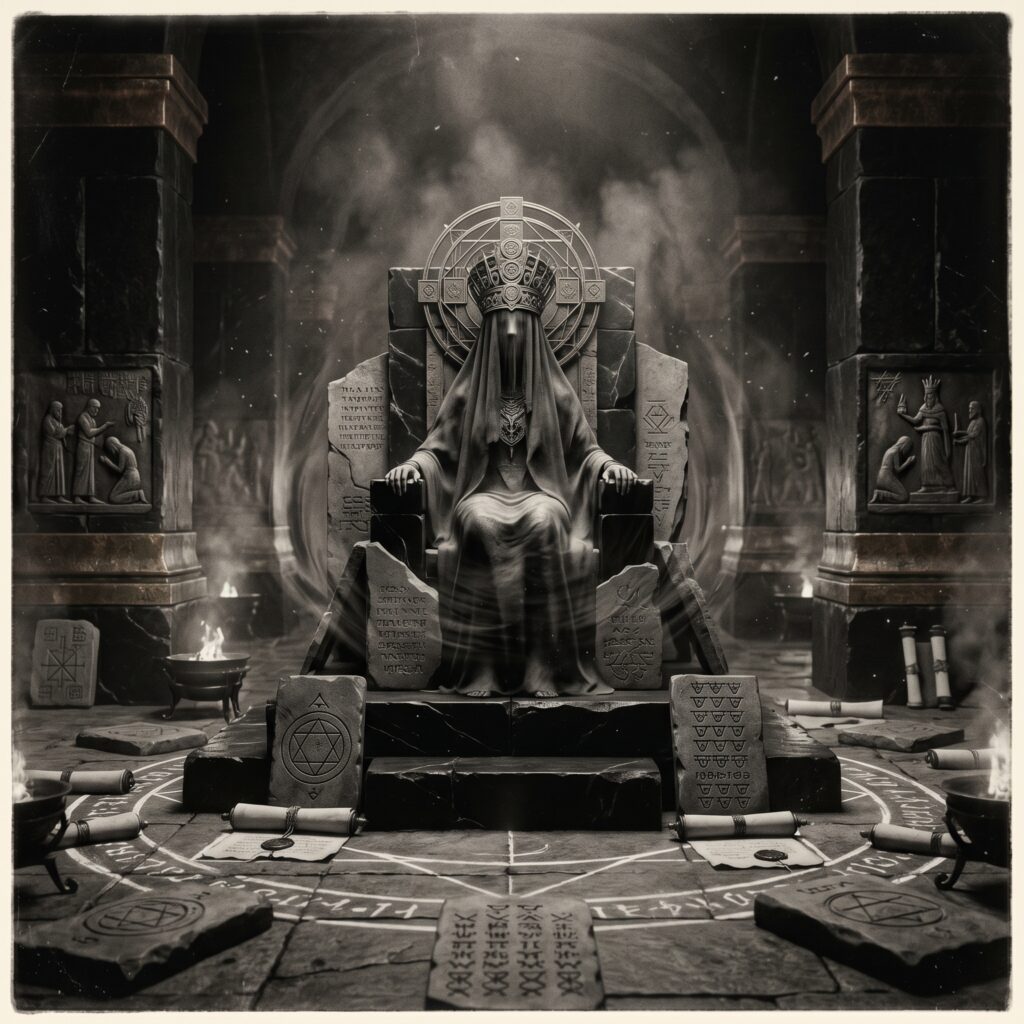
Paimon is one of the most recognizable spirits in the Ars Goetia, the 17th-century grimoire that lists 72 demons ranked within a pseudo-Solomonic hierarchy. He is the ninth spirit, a king commanding 200 legions, and his description is distinctive: a crowned figure with an androgynous, beautiful face riding a dromedary, preceded by a host of spirits playing trumpets, cymbals, and all manner of musical instruments.
He teaches arts, sciences, and secret things. He answers questions about earth, water, and wind. He bestows dignities and lordships. He gives good familiars that are good at teaching. And he requires a sacrifice if you summon him alone.
But Paimon is not originally a “demon” in the Christian sense. Before the grimoires, before the Lesser Key of Solomon, before the horror films—Paimon was a Djinn.
Djinn Origins: Before the Grimoires
The word “djinn” comes from early Arabian mythology and pre-Islamic theology. These are supernatural creatures made of “smokeless fire,” distinct from humans (made of clay) and angels (made of light). They possess free will, can be good or evil, and—crucially for understanding Paimon—can be summoned and bound to service.
Paimon’s origins trace back to this Middle Eastern djinn tradition. He is not originally a fallen angel or a Christian demon. He was a djinni—a powerful spirit king from the pre-Islamic cosmological framework. The grimoire tradition that began with the Lesser Key of Solomon (mid-1600s) took these djinn figures and “demonized” them, reframing them within a Christian hierarchy of fallen angels and hellish kings.
One researcher describes Paimon as “actually a Djinni. Yes just like in Aladdin and the Lamp”—but without the flying carpet and wish-fulfillment simplification. Traditional djinn are not immortal; they can bring disease and madness.
When the grimoires describe Paimon as “once of the Order of Dominations” or “partly of the order of angels, and partly of potestates” (spiritual powers), they are retrofitting a djinn into a Christian angelic hierarchy. The djinn framework is older. The Christian demonology is an overlay.
This matters for practitioners. If you approach Paimon through the Solomonic grimoire lens, you are working within a Christian coercive framework—divine names, circles, triangles, binding commands. If you approach him through a djinn framework, the dynamic shifts. Djinn are not inherently submissive to the Solomonic god. They have their own wills, their own hierarchies, their own terms.
The grimoire warns: “If you call the Spirit Paimon alone, you must give an offering to him”. In djinn tradition, offerings and proper respect are standard protocol. You do not command a djinn. You negotiate.
Nature & Behavior
Paimon behaves like a king. His rank is consistent across sources: a crowned authority, king of the West (some texts specify Northwest for conjuration orientation), accompanied by subordinate kings Beball/Bebal/Labal and Abalam/Abali when properly summoned.
His voice is hoarse at first. It roars. You must command him to speak clearly in your language. This is not a sign of hostility—it is standard for many Goetic spirits. The grimoires do not describe him as aggressive, deceptive, or harmful to the conjurer. He is not a possessor. He does not drive people to madness or suicide.
What he does: he teaches. Not just reveals, but teaches—imparts skills, sciences, arts, and occult knowledge. He explains the nature of the mind. He answers questions about the earth, the waters, and the winds. This is a pedagogical function, not a prophetic one. You come to Paimon to learn, not to have your fortune told.
He also bestows dignities and lordships. This is a social function: the practitioner gains authority, temporal advancement, and social elevation. Combined with his knowledge-transmission role, this suggests Paimon is a spirit for practitioners who want to rise—in skill and in social standing.
He grants “good familiars that are good at teaching.” This implies a cascading structure: Paimon does not just teach you himself; he can give you other spirits who also teach. He is a force multiplier for occult education.
His musical procession—trumpets, cymbals, all instruments—is mentioned in every major source. This is not decorative. The name “Paimon” itself has been speculatively linked to the Hebrew word pa’amon (פעמון), meaning “bell”. A tinkling sound. A musical announcement. His arrival is heralded by noise.
One occult practitioner describes the djinn as “kind of like the loan sharks of the spiritual world”. Not malevolent by nature, but transactional. You give them proper respect and proper work, and they serve faithfully. You abuse them or fail to hold up your end, and the consequences are not theoretical.
Contact & Ritual Approaches
Paimon appears across multiple grimoire traditions. The core sources:
| Source | Date | Name | Legions | Notes |
|---|---|---|---|---|
| Pseudomonarchia Daemonum (Weyer) | 1577 | Paimon | 200 | King, camel, crown, effeminate face, musical procession |
| Livre des Esperitz | 15th-16th c. | Poymon | 25 | French variant, earlier count |
| Ars Goetia (Lesser Key) | 17th c. | Paimon | 200 | 9th spirit; Beball and Abalam as subordinate kings |
| Grimoire of Pope Honorius | 17th c.? | Bayemon | Unspecified | Southern European variant |
| Dictionnaire Infernal | 19th c. | Paimon | 200 | Reproduces standard description |
The traditional engagement method is Solomonic evocation: the circle, the triangle of manifestation, the brass vessel, ritual vestments, the use of divine names and seals. This is a coercive framework, not a devotional one. The magician commands through the authority of higher names.
Specific to Paimon:
- Orient toward the West (or Northwest in some texts).
- Summon him with his seal (the standard Goetic sigil).
- If you call him alone, a sacrifice is required to bring Beball and Abalam. The grimoires do not specify the sacrifice in modern terms; traditional interpretations include bread, wine, incense, or symbolic offerings. Blood sacrifice is not standard in contemporary practice.
- Do not be alarmed by the roaring voice. Command him to speak clearly.
The djinn interface (older, less documented):
- Approach with respect, not coercion.
- Offerings are required. Djinn do not work for free.
- The relationship is transactional, not devotional. You offer something; Paimon provides teaching or elevation.
- No circle required in traditional djinn conjuration—but that also means no protection. Solomonic magicians added the circle for a reason.
In demonolatry (modern devotional approach): Practitioners may approach Paimon as a divine figure rather than a constrained spirit. This inverts the Solomonic frame. The practitioner may light candles (often yellow or gold for kingship), chant his enn, meditate on his sigil, and invite rather than command. This is reconstruction, not historical transmission. It works for some practitioners, but it is not the Goetic method.
What is not useful: Approaching Paimon through the Hereditary lens (possessive, malevolent). That is a film character, not the grimoire spirit. If you summon expecting the movie version, you are summoning something else—or summoning nothing at all.
Working With the Entity
Paimon is a teacher and a patron of advancement. Practitioners work with him for several distinct purposes.
Knowledge acquisition: The primary function. Paimon teaches arts, sciences, secret things. This can include occult skills (divination, spirit work, magical theory) and mundane subjects (philosophy, music, mathematics). He is not a one-question oracle; he is a tutor. Sustained engagement yields skill development, not just answers.
Social elevation: He bestows dignities and lordships. Practitioners report increased authority in their professional or social contexts, sometimes quite literally (promotions, leadership roles, recognition). This is not luck magic. It is structural: the practitioner becomes someone who commands authority, partly through their own development, partly through Paimon’s influence on the social field.
Familiar acquisition: He grants familiars that are good at teaching. This means working with Paimon can open doors to other spirits. He is not jealous or possessive. He delegates.
The djinn transaction model: One experienced practitioner advises: “Don’t take advantage of the occupant. Give [the Djinn] its proper job, don’t abuse it, and in return it will faithfully serve the magician, without being a spiritual asshole”. This is the djinn framework: clear terms, mutual respect, no exploitation.
Practical effects reported (from Goetic practitioners, demonolaters, and djinn-workers):
- Increased clarity in learning complex subjects
- Ability to retain and integrate esoteric knowledge faster
- Social presence that others perceive as authoritative or dignified
- Career advancement, particularly in knowledge-based or authority-oriented fields (academia, law, management, clergy)
- Musical skill development (consistent with his procession imagery and possible bell-name etymology)
- A sense of being “crowned” or elevated in personal identity
Potential negative patterns:
- Pride or arrogance as the sense of dignity solidifies
- Frustration with slower practitioners or subordinates
- Overidentification with kingship leading to social friction
- Dependency on Paimon for teaching rather than developing independent learning skills
- If the djinn framework is disrespected (no offerings, abuse of the spirit, breaking agreements): practitioners report the spirit may withdraw its services, cause disruption, or simply leave. Paimon is not described as vengeful in the sources, but djinn are not doormats.
Paimon is not wrathful, predatory, or destabilizing in the sources. But his gifts can amplify existing tendencies. If you are prone to arrogance, you will become more arrogant. If you are prone to isolation, the “kingship” function may cut you off from peers.
Stability, Risk, and Failure Modes
What helps stabilize engagement:
- Clear intent. He is a teacher and bestower of dignities. Approach him for those purposes.
- Consistency. Like any tutor, he responds to sustained work better than one-off requests.
- Respect for the Goetic frame if using Solomonic methods. Command, but command cleanly. Do not grovel.
- If using djinn framework: proper offerings, clear terms, no exploitation.
- Grounding after contact. Paimon’s energy is expansive, intellectual, and authority-oriented. It can leave the practitioner scattered or overstimulated without proper closure.
What destabilizes engagement:
- Treating him as the Hereditary version (malevolent, possessive). This is working with a different entity.
- Lack of respect for his rank. He is a king. Approach him as such, whether commanding or inviting.
- Fragmented practice—evoking him once for knowledge and then ignoring him. He is not a search engine.
- Overidentification with the “king of the West” imagery to the point of losing practical grounding.
- In djinn framework: failing to provide offerings, breaking agreements, treating a djinn as a slave rather than a partner.
Failure modes:
- The evocation simply does not work. Paimon does not appear. This is the most common failure. Check your ritual precision, orientation, and offerings.
- The knowledge imparted is overwhelming or hard to integrate. Some practitioners report receiving far more than they can process.
- Social consequences from bestowal of dignities—rapid advancement can alienate peers or provoke jealousy.
No traditional sources describe Paimon as dangerous in the sense of attacking or possessing the conjurer. The grimoires and djinn traditions are consistent on this point. He is not Lamashtu or Amprodias. His risks are social and psychological, not existential—provided you treat him with the respect his rank requires.
Cross-Tradition Differences
| Source/Tradition | Name | Nature | Interaction Mode | Notes |
|---|---|---|---|---|
| Pre-Islamic Arabian | Paimon (djinn) | Djinni (smokeless fire being) | Transactional, offerings required | Older framework; Paimon as powerful spirit king |
| Pseudomonarchia Daemonum | Paimon | Demon (Order of Dominions) | Solomonic evocation | Christian reframing of djinn |
| Ars Goetia | Paimon | 9th Spirit, King of the West | Solomonic evocation, sacrifice required | Standard Goetic version |
| Grimoire of Pope Honorius | Bayemon | Demon | Evocation | Southern European variant |
| Abramelin | Paimon | Duke | Sacred magic | Different hierarchy |
| Modern demonolatry | Paimon | Deity/demon | Devotional invitation | Inversion of Solomonic coercion |
| Hereditary (film) | Paimon | Possessing entity, malevolent | Horror narrative | NOT grimoire-accurate |
| Genshin Impact | Paimon | Floating guide/fairy | Video game character | Name only; no functional connection |
What remains consistent: Crowned, camel/dromedary, musical procession, knowledge-teaching, dignity-bestowing. The core functional archetype (knowledge transmission + social elevation) survives across 500 years of textual transmission and across cultural frameworks—from pre-Islamic djinn to Christian demon to modern occult figure.
What changes: The legions count (200 vs 25), the hierarchical details (king vs duke), the ritual frame (Solomonic coercive vs djinn transactional vs modern devotional). The biggest shift is the film version, which inverts the valence entirely.
Long-Term Practitioner Effects
Practitioners who work with Paimon consistently for years report patterns.
Positive:
- Deep, broad knowledge across multiple domains. Paimon does not specialize; he teaches arts and sciences in general.
- Natural authority that appears effortless. The practitioner becomes someone others instinctively defer to.
- Effective teaching ability. Paimon’s gift includes the capacity to transmit knowledge to others.
- Musical skill development, even in practitioners who did not previously play instruments.
- In djinn framework: A stable, long-term transactional relationship with a powerful spirit. Clear terms, clear outcomes.
Mixed:
- Social distance. Kingship is lonely. Some practitioners report difficulty maintaining equal friendships after sustained Paimon contact.
- Intellectual arrogance. The more you know, the more obvious everyone else’s ignorance becomes. This can become a character flaw.
- In djinn framework: The transactional nature can feel cold to practitioners accustomed to devotional relationships.
Negative (reported but less common):
- Inability to learn from human teachers. Paimon is so effective that human instruction feels slow and frustrating.
- Overexpansion. The practitioner takes on too many knowledge projects, too many dignities, too many responsibilities.
- If the djinn relationship is mismanaged: Paimon may simply stop working with you. No dramatic punishment—just withdrawal.
Paimon does not appear to produce psychological fragmentation, identity dissolution, or mental illness. He is structurally stabilizing—he builds knowledge and authority. The risks are social and ego-related, not existential.
Practitioner Notes
Who works well with Paimon:
- Knowledge workers (academics, writers, researchers, programmers, occultists)
- Practitioners seeking social or professional advancement
- Those who learn quickly and want to learn faster
- People comfortable with authority and leadership roles
- Musicians and sound-oriented practitioners (his processional function)
- Practitioners comfortable with transactional spiritual relationships (djinn framework) OR coercive (Solomonic) OR devotional (demonolatry)—Paimon seems adaptable, but your framework matters
Who should avoid:
- Practitioners seeking emotional comfort or nurturing (wrong domain)
- Those who cannot handle social elevation (the “kingship” function can be isolating)
- People who need strict egalitarianism in relationships (Paimon creates hierarchy)
- Anyone who wants the Hereditary horror experience—go watch the film instead
- Practitioners who cannot maintain consistent offerings or agreements (djinn framework will not work for you)
Solo vs institutional: Goetic work is traditionally solo or small-group. Djinn conjuration can be solo. Demonolatry is often solo. No institutional structure required—but no institutional protection either.
Compatibility with other systems:
- Works within Solomonic / Goetic framework (circle, triangle, divine names)
- Works within djinn framework (offerings, respect, clear terms, no coercion)
- Integrates with demonolatry if you invert the coercive frame (invite instead of command)
- Can be syncretized with cardinal/elemental systems (king of the West = water)
- Conflicts with purely internal psychological models (he is treated as external in the sources)
- Djinn framework note: Djinn are part of Islamic cosmology. Non-Muslim practitioners should be aware of this cultural origin and approach with respect, not appropriation.
The Djinn Distinction: Why It Matters
The shift from djinn to demon is not just historical trivia. It changes how you engage Paimon.
In the djinn framework:
- Paimon is not fallen, not evil, not a servant of Lucifer. He is a powerful spirit made of fire, with his own will and his own agenda.
- You do not command a djinn through divine names. You negotiate. You offer. You build a relationship based on mutual benefit.
- The circle is not for protection from Paimon. It is for protection from everything else that might show up when you open that door.
- Offerings are not optional. They are the currency of the transaction.
In the Solomonic framework:
- Paimon is a demon, a fallen angel, bound to serve the magician through the authority of the Christian god.
- You command. You do not negotiate. The circle is a containment device.
- Offerings are required only if you summon him alone—and even then, the offering is part of the binding, not a gift.
In modern demonolatry:
- Paimon is honored as a deity or a powerful spirit.
- You invite. You do not command. The relationship is devotional.
- Offerings are gifts, not payments.
All three frameworks produce results for different practitioners. The key is to be consistent. Do not mix frameworks unless you know exactly what you are doing.
The Bottom Line
Paimon is a teacher and a patron of dignity. He is also a djinn—a spirit of smokeless fire from pre-Islamic Arabian cosmology, later demonized by Christian grimoires, later romanticized by pop culture, later flattened into a horror villain by Hollywood.
Strip away the overlays, and the core remains: a crowned king of the West, riding a camel, heralded by music, who teaches arts and sciences and raises those who work with him to positions of authority.
He is not a horror monster. He is not a possessor. He is not a destroyer. He is one of the more straightforward spirits in the Goetic corpus: approach him with respect, clear intent, and the proper ritual frame—whether coercive, transactional, or devotional—and he will teach you what you need to know and help you rise.
Just do not forget the offering. And do not treat a djinn like a slave.