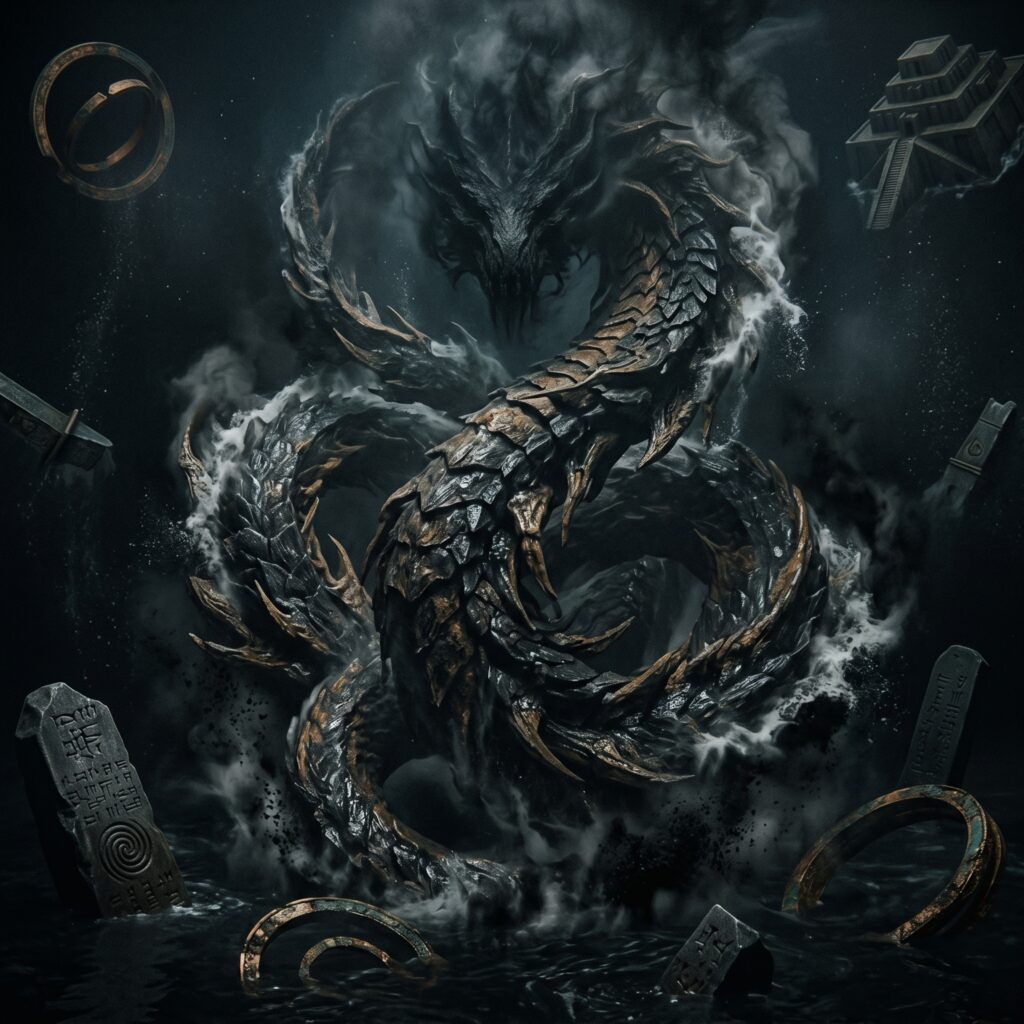
1. What This Entity Is
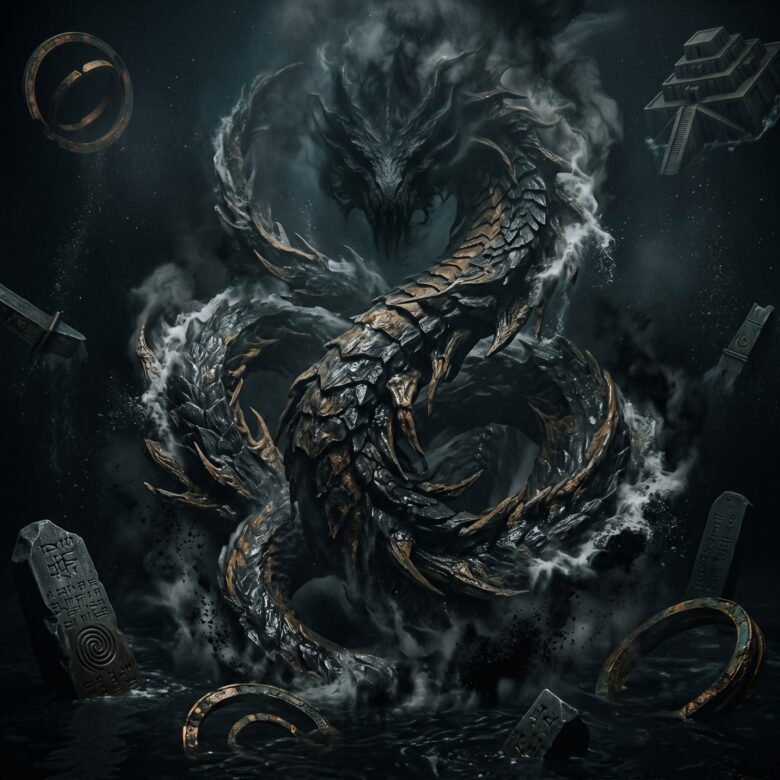
Tiamat is the primordial salt water sea personified in Babylonian cosmology, best known from the Enūma Eliš (circa 1100–600 BCE). Her name is cognate with tamtu (Akkadian for “sea”). She is the chaos monster who opposes the younger gods and is slain by Marduk, whose body is then used to create heaven and earth.
She has no temple, no offerings, no cult. She appears in narrative—specifically, in the cosmogonic epic that legitimates Babylon’s rise—not in ritual practice. The Sumerian antecedent Nammu (primordial sea, mother of gods) is not adversarial. Tiamat is. That shift defines her function.
In later transmission, her name becomes cognate with Tehom (“the deep”) in the Hebrew Bible, but the entity herself does not persist as an operational figure. She belongs to the category of beings who exist to be overcome so that order can emerge.
2. Core Behavior Pattern
Tiamat in the Enūma Eliš behaves as a reactor, not an initiator. She does not attack first. Her consort Apsu (primordial fresh water) is murdered by the younger gods while he sleeps. Only then does Tiamat convene a war council, create eleven monsters, and raise Kingu as her general.
Her behavior is retaliatory. She fights when confronted. She does not negotiate. When Marduk challenges her, she engages directly and is defeated. Her body is split: half becomes the sky, half becomes the earth.
After her death, she has no further behavior. She does not return. She does not persist as an active presence.
The asakku class (derived from Asag) persists as operational demons. Tiamat does not. She is a one-time cosmogonic event, not a recurring contactable presence.
3. Traditional Contact Methods
None. Zero. Not attested.
Tiamat is not invoked, offered to, prayed to, or contacted in any surviving Mesopotamian source. The Enūma Eliš was recited during the Akitu (New Year’s) festival in Babylon, but the recitation is a narrative re-enactment of Marduk’s victory—not an invocation of Tiamat. She appears in the story as the defeated opponent. The ritual is about Marduk’s order, not her presence.
What does not exist:
- Invocation formulas
- Epithets for ritual address
- Offering structures
- Temple or domestic cult
- Curse formulas using her name
- Any method for calling her to presence
Tiamat is a narrative figure, not an operational one.
4. How Practitioners Work With It
Engagement Modes (Attested)
None. There is no attested engagement mode for Tiamat in Mesopotamian tradition. The dossier cannot describe what does not exist.
Engagement Modes (Modern Reconstruction Only)
Some contemporary magical traditions—particularly Thelemic (Kenneth Grant’s Typhonian current) and Chaos Magic—have adopted Tiamat as a symbol of primordial chaos, the abyss, or pre-creation void. In these frameworks, she may be invoked as a force of dissolution, boundary erasure, or deep unconscious material.
These are modern inventions. They are not continuous with the Babylonian Tiamat. The name is borrowed. The operational logic is created.
Practitioner Effects (Modern Frameworks, Not Traditional)
Reports from modern practitioners working with Tiamat-as-symbol include:
- Dissolution of fixed identity structures
- Intensified dream activity with oceanic or abyssal imagery
- Temporary disorientation followed by reorganization
- Confrontation with fear of annihilation or limitlessness
These effects are not documented in Mesopotamian sources. They belong to modern esoteric currents. The dossier includes them only for completeness, with clear labeling as modern, not traditional.
LHP / Wrathful Frame Note
In Left Hand Path and chaos currents, Tiamat is sometimes treated as a force of primordial undifferentiation—a power to be navigated rather than slain. This inverts the Babylonian narrative, where her defeat is necessary for order. The modern framing is a reversal, not a recovery.
5. Conditions for Stable or Functional Work
For traditional engagement: No conditions exist because no engagement exists.
For modern reconstructed work: Conditions vary by current. No stable cross-system conditions can be stated because the frameworks are heterogeneous. Practitioners working with Tiamat in modern contexts typically report that:
- Strong ego stability is required before contact (dissolution risk)
- Structured ritual containers (circle, banishing, grounding) are often used as counterbalance
- Fragmentation or instability prior to working with Tiamat may be exacerbated
These are practitioner observations, not traditional constraints.
6. Cross-Tradition Behavior
| Aspect | Babylonian (Tiamat) | Hebrew (Tehom) | Modern Occult (Tiamat) |
|---|---|---|---|
| Type | Individuated chaos monster | Flattened “deep” (cosmographic, not personal) | Primordial chaos principle or abyss force |
| Domain | Salt water sea, pre-creation | Primordial waters (Genesis 1:2) | Unconscious, abyss, pre-order void |
| Interaction mode | None (narrative only) | None (theological background) | Invocation (modern reconstruction) |
| Function | Defeated to create cosmos | Neutral background condition | Dissolution, boundary erasure, gnosis |
The shift from adversarial monster to abstract principle to modern chaos force is dramatic. The entity does not persist continuously across these frames.
Functional parallels elsewhere (structural, not genealogical):
- Leviathan (Hebrew): sea chaos monster slain by Yahweh. Strong structural parallel, likely influenced by Mesopotamian tradition.
- Yamm (Canaanite): sea chaos deity opposed by Baal.
- Typhon (Greek): chthonic monster buried under mountains after defeat by Zeus.
- Vritra (Indo-Iranian): serpent who blocks waters, slain by Indra.
- Apophis (Egyptian): primordial serpent of chaos opposed by Ra daily.
Tiamat is the Babylonian instantiation of a widespread chaos-adversary archetype.
7. Long-Term Effects of Engagement
For traditional framework: No engagement, no effects.
For modern reconstructed work: Documented patterns from practitioners include:
- Increased tolerance for ambiguity and chaos in cognitive processing
- Temporary destabilization of fixed self-narrative (can be initiatory or disintegrative)
- Heightened sensitivity to liminal and pre-conscious material
- In stable practitioners: expanded perceptual range
- In unstable practitioners: fragmentation, boundary confusion, difficulty re-establishing order
These effects are not “Tiamat’s behavior.” They are outcomes of engaging a modern constructed symbol of primordial chaos. The dossier cannot attribute them to the Babylonian entity because the Babylonian entity was never contacted.
8. Practitioner Notes (Real-World Use)
Who works with Tiamat in modern contexts: Experienced practitioners working within chaos currents, Thelemic Typhonian tradition, or experimental post-neopagan frameworks. Typically those with existing stability in confronting dissolution-based or abyssal work.
Who should avoid: Anyone prone to identity fragmentation, boundary dissolution, or severe anxiety around chaos/unstructured states. The modern Tiamat frame can amplify existing instability. Not a beginner entity.
Solo vs institutional: Modern work is almost entirely solitary or small-group. No institutional structure exists.
Compatibility with other systems: The Babylonian Tiamat has no compatibility because she has no ritual interface. The modern Tiamat-as-chaos-principle is often used in chaos magic, Thelemic, and some post-neopagan systems. She does not integrate cleanly with order-focused, devotional, or moral-duality frameworks (e.g., Christian magic, Wiccan polarity, ceremonial order magic). Conflict is likely.
Critical advisory: The dossier distinguishes sharply between:
- Tiamat of the Enūma Eliš (no ritual interface, no traditional engagement)
- Modern Tiamat constructs (borrowed name, invented operations)
If you are working with Tiamat, be clear which one. The Babylonian entity does not answer calls. The modern symbol may produce effects—but those effects belong to contemporary invention, not ancient tradition.