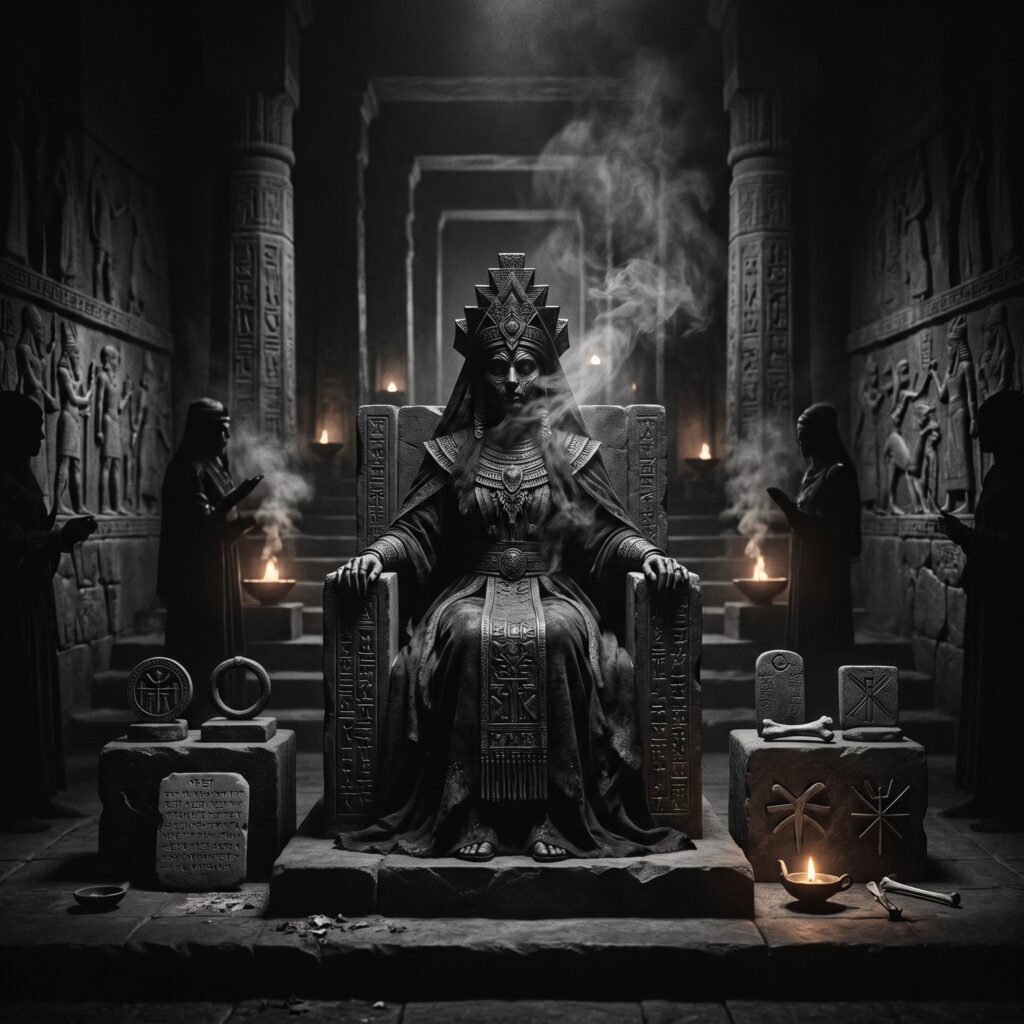
1. What This Entity Is
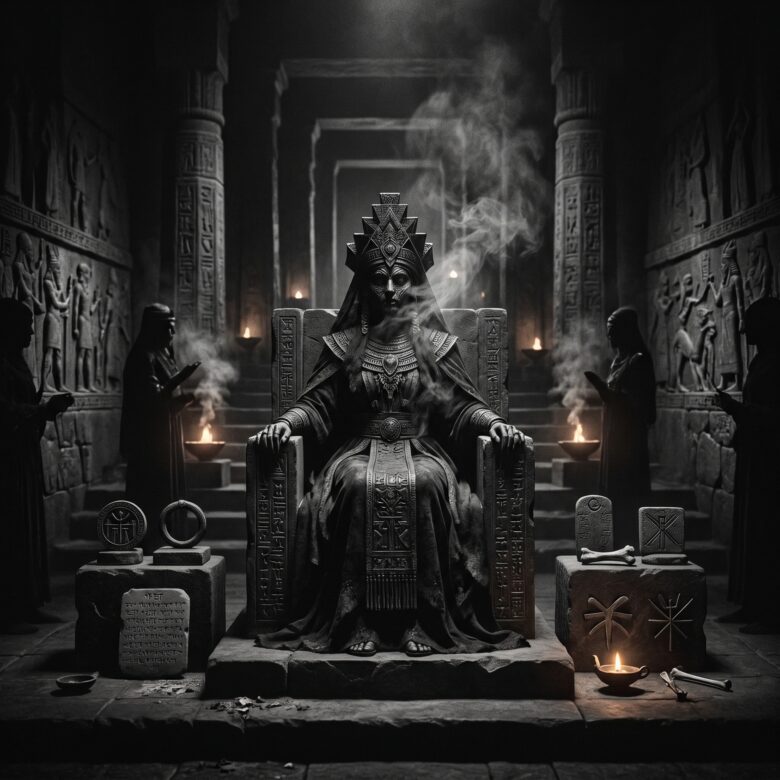
Ereshkigal is the queen of the underworld (Irkalla) in Mesopotamian tradition, spanning Sumerian through Neo-Babylonian periods (circa 2100–500 BCE). Her name translates as “Lady of the Great Earth”—a reference to the underworld, not the surface world. In Akkadian sources, she appears as Allatu or Allatum. Her domain, Irkalla, so thoroughly identifies with her that the name becomes an epithet.
She has no temple, no priesthood, no regular offerings. Unlike Nergal (state cult) or Pazuzu (domestic apotropaic), Ereshkigal’s institutional presence is through funerary contexts and magical texts. State religion acknowledged her but did not worship her. Her power was real but dangerous—requiring acknowledgment, not invitation.
She is the sister of Inanna (goddess of love, fertility, war, and political power). That sibling relationship encodes a structural polarity: the queen of the above and the queen of the below. One represents life, desire, and political ascent. The other represents death, permanence, and final accounting.
In the Nergal and Ereshkigal narrative (Akkadian period), she acquires a consort—Nergal—and sovereignty becomes shared. But she never leaves the underworld. Unlike Persephone (Greek), she has no seasonal return to the surface.
2. Core Behavior Pattern
Ereshkigal behaves as a jurisdictional sovereign. She does not hunt the living. She does not guard thresholds. She receives what arrives. All dead eventually come to her court. That is not a threat. It is a structural fact of the Mesopotamian cosmos.
In Inanna’s Descent to the Netherworld (Sumerian):
Inanna, queen of heaven, descends to the underworld. She passes through seven gates, removing at each gate a piece of her divine regalia. She arrives naked and powerless before Ereshkigal’s throne. Ereshkigal fixes her with the gaze of death. Inanna dies. Her corpse is hung on a hook.
Ereshkigal’s behavior here is defensive of her domain’s sovereignty. Inanna entered uninvited, without ritual preparation, attempting to claim territory. The killing gaze is not predation. It is border enforcement.
In Nergal and Ereshkigal (Akkadian):
Ereshkigal is portrayed as isolated, desiring union. Nergal, god of plague and war, insults her messenger. Summoned to the underworld to apologize, he is warned by Ea not to accept food, drink, or a bed—the bonds of hospitality that would trap him. He fails. He accepts. He sleeps with Ereshkigal. Then he flees.
Ereshkigal, now desiring him, threatens to release the dead upon the living unless Nergal returns. He does. He becomes her consort. Sovereignty becomes shared.
The shift from solitary autonomous sovereign (Sumerian) to married co-ruler (Akkadian) encodes political-theological changes. As male storm-gods rose in imperial pantheons, the underworld became a shared domain. Ereshkigal did not lose power. She gained a consort who matched her in destructive capacity.
3. Traditional Contact Methods
Ereshkigal has no temple cult. No regular offerings. No priesthood. This is not a gap in the record. It is a structural constraint.
Attested engagement methods (all indirect):
- Funerary offerings (libations of water, wine, food placed in graves)—offered to the dead, not to Ereshkigal
- Kispu rituals (feeding the ancestors, invoking them as intermediaries)
- Naming in curse formulas (“By Ereshkigal, Queen of the Great Earth, may you be bound”)
- Magical binding texts (late antique—her name used to seal oaths and curses)
- Necromantic boundary-pushing (high-risk, attested but condemned in standard sources)
What does not exist: Direct invocation for the living. No prayers. No offerings to her as a recipient. No temple. No domestic cult.
Invocation / address forms (textual layer):
Direct naming occurs primarily in curse and binding contexts:
“By Ereshkigal, Queen of the Great Earth”
“Ereshkigal, lady of the great below”
These are not invocations to call her presence. They are adjurations—calling her as witness or enforcer.
The Inanna’s Descent narrative describes her but does not provide ritual address formulas. The Nergal and Ereshkigal narrative does the same.
Key constraint: Ereshkigal is rarely invoked directly. The pattern is indirect approach: through her ministers (Namtar, Nedu), through the dead, or through Nergal. Direct invocation appears primarily in curse and binding contexts—never in petitionary or worship modes for the living.
4. How Practitioners Work With It
Engagement Modes
Funerary / ancestral mode (attested, primary):
The practitioner offers to the dead—libations, food, objects—acknowledging that the dead reside in Ereshkigal’s domain. This is not contact with Ereshkigal. It is relationship with ancestors who live under her authority. The practitioner never addresses her directly in this mode.
Curse / binding mode (attested, secondary):
The practitioner invokes Ereshkigal’s name to seal an oath or bind an enemy. The formula is adjuratory: “By Ereshkigal… may X be bound.” She is called as witness and enforcer. The curse is self-executing once spoken correctly. No ongoing relationship required.
Necromantic mode (attested but high-risk, condemned in some sources):
The practitioner attempts to contact the dead directly—circumventing the normal funerary structure. This risks Ereshkigal’s attention. The sources warn against it. Not standard practice.
What does not exist (in tradition):
- Devotional work to Ereshkigal
- Invocation for guidance, protection, or transformation
- Any mode where the living approach her directly without extreme necessity
Practitioner Effects (Functional Framing)
For those performing funerary offerings:
- Maintenance of relationship with ancestors
- Social cohesion through shared mortuary practice
- No direct effect from Ereshkigal—she is the context, not the contact
For those using her name in curses:
- Social authority (oaths sealed by Ereshkigal are considered irreversible)
- Psychological finality (the curse is done; no revision)
- Risk: if the curse is unjust, the practitioner may be seen as dangerous or unhinged (social, not magical consequence)
LHP / Wrathful Frame Note
In contemporary Left Hand Path contexts, Ereshkigal is sometimes approached as a sovereignty figure—the queen who does not leave, who rules absolutely, who enforces final boundaries. Practitioners working with this frame report:
- Increased ability to enforce personal boundaries with finality
- Reduced fear of death or endings
- Capacity to sit with irreversible decisions without regret
- Confrontation with one’s own mortality as a grounding force
This is modern application. The traditional sources do not support invocatory work with Ereshkigal. Practitioners using this frame should distinguish between historical Ereshkigal (no ritual interface) and the modern sovereignty construct bearing her name.
5. Conditions for Stable or Functional Work
For funerary / ancestral offerings (attested):
- Correct placement (grave sites, ancestral shrines)
- Correct offerings (water, wine, food appropriate to the dead)
- Proper intent (honoring the dead, not petitioning Ereshkigal)
- Consistency (neglect of ancestors may be seen as abandonment, but no Ereshkigal backlash is documented)
For curse / binding formulas (attested):
- Precise formulaic language
- Named target and specific binding condition
- Ritual context (written tablet, verbal declaration in formal setting)
- No personal relationship with Ereshkigal required—transactional witness dynamic
Destabilizing conditions:
- Direct invocation of Ereshkigal outside curse contexts (no documented outcome, but no traditional support either)
- Necromantic boundary-pushing without proper protection (attested as high-risk)
- Ritual error in curse formulas (may invalidate binding)
For modern sovereignty work (not attested, practitioner reports):
- Strong ego stability required (confronting death and finality can be destabilizing)
- Clear boundary definition (Ereshkigal’s energy is not diffuse; it is absolute)
- Integration with grounding practices to prevent dissociation or morbid fixation
6. Cross-Tradition Behavior
| Aspect | Sumerian (Ereshkigal) | Akkadian (Ereshkigal/Allatum) | Neo-Assyrian (with Nergal) | Modern Occult (Ereshkigal) |
|---|---|---|---|---|
| Type | Autonomous underworld sovereign | Underworld sovereign (Allatum) | Co-ruler with Nergal | Sovereignty / death / boundary figure |
| Domain | Irkalla (underworld) | Irkalla | Irkalla (shared with Nergal) | Death, endings, absolute authority |
| Consort | None | None (before marriage narrative) | Nergal | Sometimes Nergal, sometimes solitary |
| Interaction mode | None (narrative only) | None (narrative) + curse formulas | Curse formulas + funerary context | Modern invocation (reconstructed) |
Stable elements across traditions: Absolute sovereignty, no escape from her domain, association with judgment and finality, sister of Inanna.
Functional parallels elsewhere (structural, not genealogical):
- Persephone (Greek): underworld queen—key difference: Persephone leaves annually; Ereshkigal never leaves
- Hel (Norse): underworld ruler, receives non-combatant dead—key difference: Hel’s domain is one region among several; Ereshkigal’s is universal
- Mictēcacihuātl (Aztec): underworld queen, rules Mictlan with Mictlantecuhtli—closer structural parallel: receives all who die naturally
Ereshkigal’s permanent sovereignty distinguishes her from most underworld queens in other traditions.
7. Long-Term Effects of Engagement
For traditional funerary practice (attested): Sustained engagement with ancestor offerings produces social cohesion, continuity of memory, and cultural stability. No direct effects from Ereshkigal are documented because she is not contacted.
For curse practitioners using her name (attested): Repeated use of Ereshkigal’s name in binding formulas establishes a reputation for finality. Oaths sealed by her name are considered unbreakable. The practitioner gains social authority as an enforcer of irreversible agreements.
For modern sovereignty-oriented practitioners (not attested, practitioner reports):
- Increased comfort with finality, endings, and irreversible decisions
- Reduced anxiety around death and mortality
- Strengthened capacity to say “no” without negotiation
- Potential for social friction (others may perceive the practitioner as rigid or unforgiving)
- Risk of isolation if boundary enforcement becomes excessive
These effects are reported by practitioners working with Ereshkigal in Left Hand Path or sovereignty-focused contexts. The dossier presents them as observed patterns, not traditional claims.
8. Practitioner Notes (Real-World Use)
Who works well with Ereshkigal:
- Practitioners needing to enforce absolute boundaries (legal, relational, psychological)
- Those comfortable with finality and irreversible decisions
- Individuals with existing ego stability (Ereshkigal’s energy is not diffuse; it is absolute)
- Those working with death, dying, or ancestor traditions
- Practitioners in Left Hand Path or sovereignty-focused currents
Who should avoid:
- Anyone seeking gentle guidance, nurturance, or conditional relationships (wrong domain)
- Practitioners prone to rigid boundary enforcement as a defense mechanism (Ereshkigal will amplify, not soften)
- Those with unresolved death anxiety or unresolved grief (may destabilize)
- Anyone who needs reversible outcomes or negotiable terms (Ereshkigal’s domain is final)
Solo vs institutional: Historically, no institutional cult existed—only funerary practice and curse formulas. Modern practitioners can work with her in sovereignty contexts without institutional container, but strong personal structure is required.
Compatibility with other systems:
- Works within Mesopotamian pantheon structure (paired with Nergal, sister of Inanna)
- Compatible with death-focused or ancestor traditions across cultures (functional overlap, not syncretism)
- Conflict likely with purely life-affirming, resurrection-focused, or cyclical-return systems (Ereshkigal does not release what enters her domain)
- Does not fit Christian demonology frameworks (Ereshkigal is a sovereign, not a fallen angel)
- Can integrate with other underworld queen traditions (Persephone, Hel, Mictēcacihuātl) through comparative structural mapping, not forced merging
Key advisory: Ereshkigal does not answer calls for the living in traditional sources. Funerary offerings go to the dead, not to her. Curse formulas invoke her as witness, not as a contacted presence. Modern invocatory work is invented, not transmitted. If you choose to work with her directly, you are operating outside attested tradition. Be clear about that distinction.