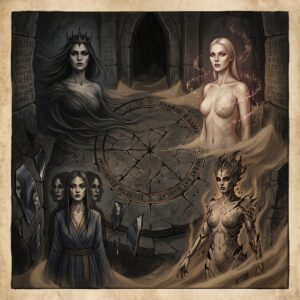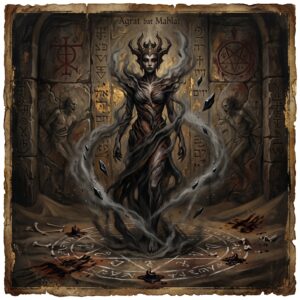
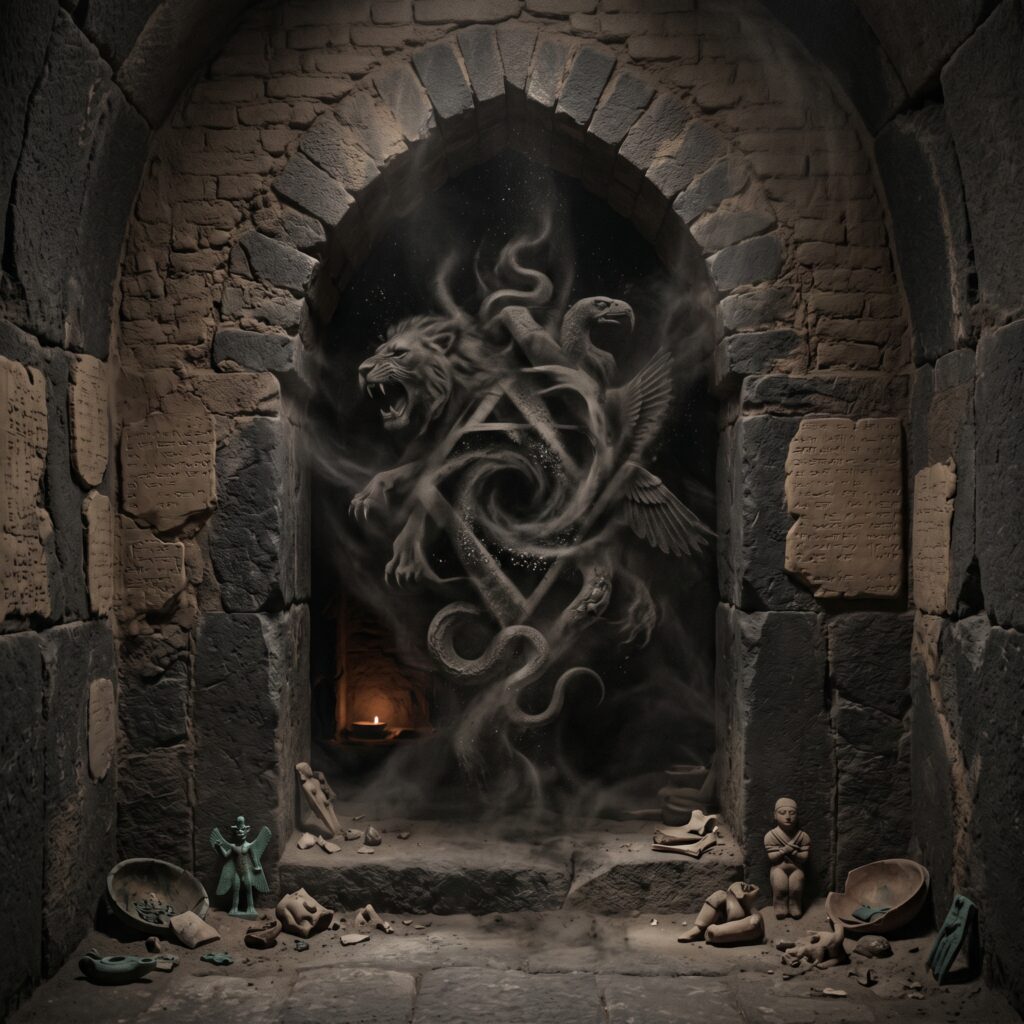
She comes through the window. Not the door. The door can be sealed. The door can hold a Pazuzu head. The window is a gap. The roof opening is a vulnerability. The unsealed threshold is an invitation she does not require.
Lamashtu is not a demon in the European sense. She does not serve a higher power. She is not fallen, punished, or morally compromised. She is not a tempter or a tester of faith. She is a function: maternal-infanticidal threat, biological predator, liminal opportunist.
She appears in Mesopotamian texts from the Old Babylonian through Neo-Assyrian periods, roughly 1800 to 600 BCE. Her Sumerian name is Dimme. Her Akkadian variants include Lamasshtu and Labartu. One epithet is “She Who Erases”—what she does to pregnancies, newborns, and nursing mothers.
She has no cult, no offerings, no invocations. No one worshipped her. No one prayed to her. The only relationship documented is apotropaic: identify her, describe her, drive her out.
Nature & Behavior
Lamashtu is a predator of gaps. She does not need an invitation. She does not require ritual error or moral failing. She exploits architecture: windows, unsealed doorways, roof openings. She works in the liminal hours before dawn.
Her targeting is brutally specific:
- Pregnant women (causes miscarriage)
- New mothers (fever, mastitis, postpartum death)
- Nursing infants (sudden illness, failure to thrive, death during sleep)
- Breast milk (corrupts it—makes it poisonous or insufficient)
- The umbilical cord and womb (entry points for her influence)
She also contaminates water sources and blights crops, but her primary operational domain is the biological vulnerability of reproduction.
Unlike later European demons that require invitation or contract, Lamashtu operates by proximity alone. She is closer to a disease than a moral agent. No textual tradition frames her as serving a higher power or being punished for rebellion. She simply is.
Standard apotropaic measures—incense, water libations, ordinary protective spirits—do not stop her. The incantation texts are explicit on this point. She ignores or overcomes the usual protective hierarchy.
Only one thing works: Pazuzu.
Lamashtu sees his image at the threshold and goes elsewhere. Her behavior is avoidance, not submission. She does not negotiate. She does not bargain. She re-routes.
Contact & Ritual Approaches
There is no such thing as “contacting” Lamashtu in traditional sources. The category does not exist. All surviving material is about repelling her.
Attested methods (all defensive, all apotropaic):
- Pazuzu head amulets (bronze or clay) placed at doorways, windows, and birth houses
- Lamashtu plaques showing her image in a bound or constrained posture (visual capture)
- Incantations from the Series Lamashtu, which describe her while commanding her departure
- Apotropaic plants placed at entry points: tamarisk, juniper, thorny species
- Thresholds marked with flour or water to create a barrier
What does not exist:
- Any invocation formula to call her
- Any offering or appeasement ritual
- Any text suggesting it is safe or productive to seek contact
The incantations name her functionally:
“Lamashtu, daughter of Anu”
“She Who Erases”
This is identification for repulsion, not address. Describing her too precisely without protective images present may attract her attention—the sources warn against it. Rituals generally name her while simultaneously deploying apotropaic materials.
The structure is: identify, describe, expel. Nothing else.
Working With the Entity
You don’t. Not in the traditional sense.
The practitioner works against Lamashtu, not with her. The relationship is adversarial by design.
Attested practitioner modes:
- Apotropaic protector (household head, birth attendant, exorcist): Places images, recites incantations, seals thresholds. Acts as a filter between Lamashtu and vulnerable targets (pregnant women, newborns, new mothers).
- Exorcistic specialist (trained āšipu): Diagnoses Lamashtu’s presence through symptom patterns (unexplained fever, infant death, maternal illness). Performs expulsion rituals with precision. Requires deep knowledge of incantation series and plant properties.
Practical effects traditionally associated:
- Reduced incidence of unexplained infant death and maternal fever (within the system’s logic)
- Contained anxiety around domestic vulnerability
- No relationship with the entity—only expulsion
Modern adversarial / sovereignty-oriented approaches (not attested historically):
Some contemporary Left Hand Path practitioners approach Lamashtu as a boundary-testing force—a figure who cannot be reasoned with, only redirected or avoided. Facing her symbolic energy without collapsing is treated as a sovereignty threshold.
Reported effects from this modern frame:
- Increased capacity to sit with vulnerability around death, particularly infant/maternal death
- Strengthened ability to enforce boundaries against intrusive forces
- Confrontation with unresolved grief or trauma
- Risk of destabilization if the work unearths suppressed material
This is modern application. The historical record does not support invocatory work with Lamashtu. Practitioners using this frame should know they are inventing, not recovering.
Stability, Risk, and Failure Modes
What stabilizes apotropaic work (attested):
- Correct placement of images (thresholds, windows, birth houses—facing outward)
- Accurate incantation recitation
- Fresh, properly prepared apotropaic plants
- Ritual purity of the practitioner
- Consistent maintenance of protective measures
What destabilizes it:
- Failure to seal entry points (windows, roof openings, gaps in walls)
- Incorrect or incomplete incantations
- Removal of protective images before the threat period ends
- Naming Lamashtu without protective images present (sources suggest this may attract attention)
For modern boundary-testing work (practitioner reports, not traditional):
- Strong ego stability required (infant/maternal death symbolism is intense)
- Clear ritual container needed to return to normal state
- Not recommended for anyone with unresolved pregnancy or infant loss trauma
- Risk of retraumatization if the work unearths suppressed grief
Cross-Tradition Differences
Lamashtu appears across multiple periods and cultures with remarkable consistency.
| Tradition | Type | Interaction Mode |
|---|---|---|
| Old Babylonian | Individuated infanticidal demon | Apotropaic (expulsion) |
| Neo-Assyrian | Individuated demon (paired with Pazuzu) | Apotropaic via Pazuzu |
| Jewish-Aramaic bowls | Syncretic demon figure | Apotropaic (bowl inscriptions) |
Stable elements across all traditions: Targets mothers and infants. Enters through gaps. Cannot be reasoned with. Only expelled or avoided.
Functional equivalents elsewhere (structural, not genealogical):
- Lilith (Jewish): Infant-threat figure, attacks newborns and mothers. Key difference: Lilith has a backstory (Adam’s first wife), a moral framework, and eventual incorporation into demonological hierarchies. Lamashtu has none of these.
- Gello (Greek): Virgin/child-threatening spirit, targets postpartum women and infants.
- Al (Armenian): Postpartum threat entity, similar entry patterns.
- Lamiae (Greco-Roman): Child-targeting female demons, often with composite features.
Lamashtu is the earliest and most fully articulated version of this stable symbolic niche. High-mortality civilizations generate functionally similar figures regardless of genealogical transmission. The problem—unexplained infant death, maternal fever, stillbirth—requires a symbolic container.
Long-Term Practitioner Effects
For traditional apotropaic practice (attested): Sustained use of Lamashtu countermeasures produces no relationship with the entity—only continued repulsion. Households that maintain proper protections report fewer instances of unexplained infant death and maternal fever (within the logic of the system). The effects are attributed to the protection working, not to any change in Lamashtu’s behavior.
Exorcists specializing in Lamashtu develop deep symptom pattern recognition, diagnostic precision, and reputation as maternal-infant protection specialists. No documented personal transformation beyond professional expertise.
For modern boundary-testing practitioners (practitioner reports, not traditional):
- Increased tolerance for confronting death-related imagery and vulnerability
- Reduced fear of intrusive forces (symbolic or psychological)
- Potential for increased anxiety around maternal-infant health if unresolved issues exist
- Risk of retraumatization if the work unearths suppressed grief
These effects are reported by practitioners working with Lamashtu in experimental or Left Hand Path contexts. The dossier presents them as observed patterns, not traditional claims.
Practitioner Notes
Who works well with Lamashtu (apotropaic mode, attested):
- Household heads, birth attendants, exorcist priests
- Anyone responsible for protecting vulnerable individuals (pregnant women, newborns, new mothers)
- Those who can maintain ritual precision under stress
Who works well with Lamashtu (modern boundary-testing mode, not attested):
- Experienced practitioners with strong ego stability
- Those with resolved grief around death and loss
- Individuals who do not have unresolved pregnancy or infant loss trauma
- Practitioners comfortable with adversarial or fear-facing work
Who should avoid (both modes):
- Anyone with unresolved trauma around infant or maternal death (may destabilize)
- Practitioners seeking relationship, alliance, or worship (wrong domain)
- Those prone to boundary diffusion or magical over-identification with threat figures
- Beginners without strong grounding and protective structures
Solo vs institutional: Historically, apotropaic work was domestic or exorcistic (temple-trained specialists). Modern practitioners can work solo but need clear protective structures. Lamashtu is not a figure for improvisation.
Compatibility with other systems:
- Works within Mesopotamian apotropaic framework (paired with Pazuzu)
- Compatible with other maternal-infant protection systems through functional comparison
- Does not fit Christian demonology frameworks (Lamashtu has no fall, no service to Satan, no moral backstory)
- Can integrate with other infant-threat apotropaics (Lilith repulsion, etc.) through structural mapping, not syncretism
The bottom line: Lamashtu is not a figure to be invoked, worked with, or worshipped. The sources are unanimous: she is identified, described, and repelled. Any work that treats her as an ally, teacher, or source of power operates outside attested tradition. The modern boundary-testing frame is an invention—legitimate as contemporary practice for those who know what they are doing, but not continuous with the Lamashtu of the tablets and bowls.
She comes through the window. You place Pazuzu at the door. That is the relationship. Everything else is speculation.