Overview
Overview
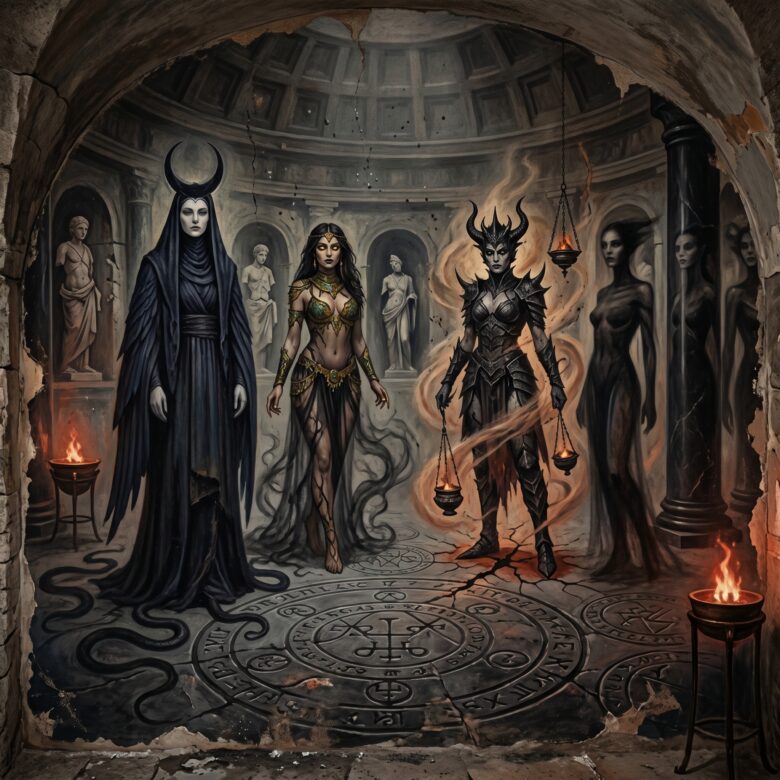
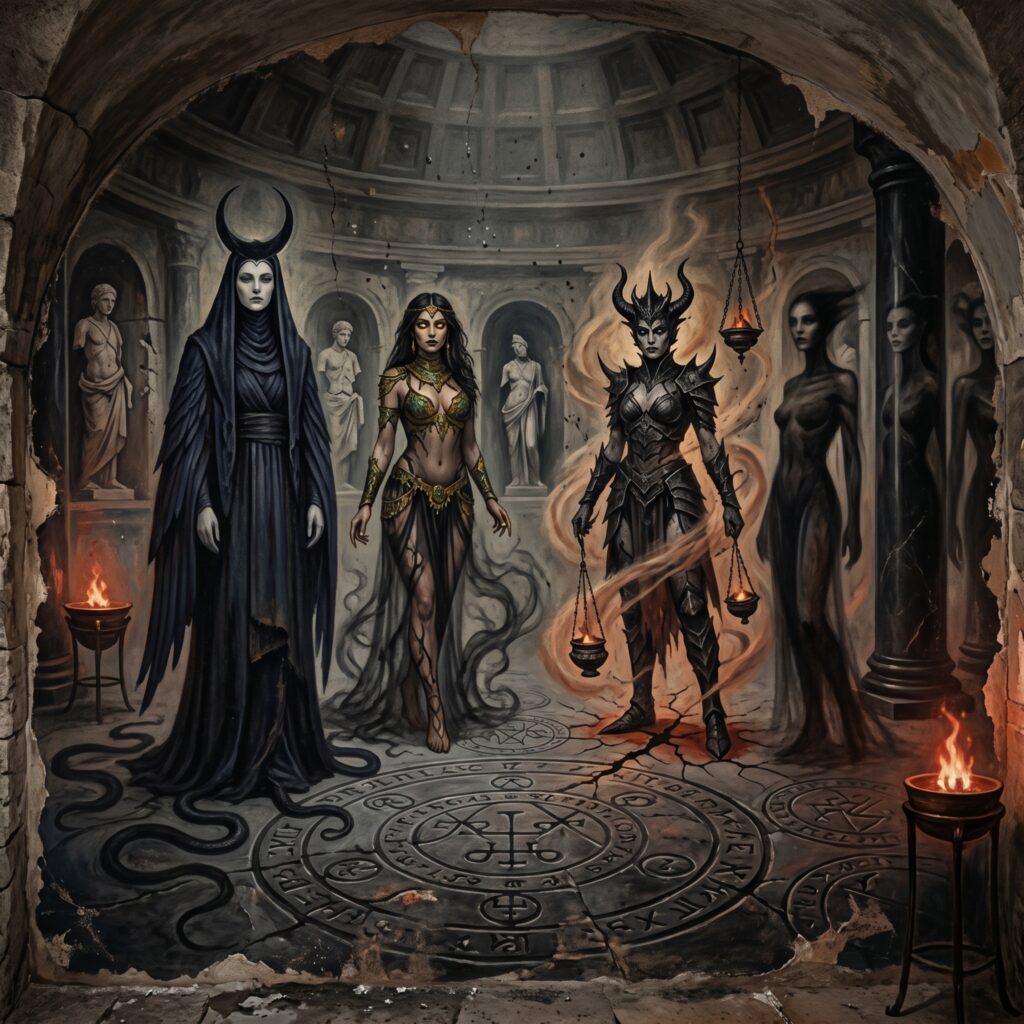
This ritual invokes the Four Queens of Demons—Lilith, Naamah, Agrat bat Mahlat, and Eisheth Zenunim—for the purpose of consecrating a working space and opening a portal to the sitra achra (the “other side”). It draws from Goetic hierarchy (the Four Queens as rulers of legions), PGM-style invocation (direct voces magicae, rhythmic repetition, and forceful calling), Picatrix astral ritual structure (timing, offerings, planetary correspondences), and Tantric sadhana techniques (visualization, mantra recitation, pranayama, and the fourfold gate sequence). The ritual adapts Tibetan Buddhist four-directional mandala offerings and deity yoga visualization—but without Tibetan Buddhist imagery, deities, or cultural markers. The space becomes a threshold. The Four Queens become the gate.
This is not protective circle casting in the Solomonic or Golden Dawn sense. There is no banishing, no LBRP, no invoking of archangels or divine names for protection. The Four Queens are invited as the sovereign guardians and activators of the portal. The practitioner stands in the court of the Four Queens, not above them.
What the Ritual Does
The ritual of the Four Queens consecrates a working space as a portal to the Qliphothic current associated with Lilith, Naamah, Agrat bat Mahlat, and Eisheth Zenunim. It marks the space as belonging to the sitra achra, opens a passage for the Four Queens’ presence, and establishes the practitioner as a sovereign operator within that space—not a supplicant, not a commander, but a co-participant in the shadow hierarchy of the Four Queens.
The ritual of the Four Queens produces three distinct outcomes:
- Spatial consecration of the Four Queens — The room or outdoor area becomes ritually distinct from ordinary space. The Four Queens—Lilith, Naamah, Agrat bat Mahlat, and Eisheth Zenunim—are acknowledged as its patrons. Thresholds (doors, windows, the circle’s edge) become permeable to Qliphothic current under the authority of the Four Queens.
- Portal opening through the Four Queens — A passage is created through the invocation of Lilith, Naamah, Agrat bat Mahlat, and Eisheth Zenunim. This is not a physical opening but a perceptual and energetic one. Practitioners working with the Four Queens report a shift in atmosphere: cooler temperature, pressure change, altered light perception, a sense of being watched or accompanied by Lilith, Naamah, Agrat bat Mahlat, and Eisheth Zenunim.
- Practitioner attunement to the Four Queens — The operator becomes calibrated to the frequencies of Lilith, Naamah, Agrat bat Mahlat, and Eisheth Zenunim. This is not possession or channeling of the Four Queens. It is an alignment of attention, breath, and symbolic awareness with each Queen’s domain.
The ritual of the Four Queens is an opening, not a closing. It prepares a space for further work: evocation of the Four Queens, divination through the Four Queens, dream incubation with Lilith, Naamah, Agrat bat Mahlat, and Eisheth Zenunim, or sustained Qliphothic practice in the presence of the Four Queens. It must be followed by a closing ritual or natural dissipation (daylight, crossing the threshold outward, etc.). Left open, the portal of the Four Queens may bleed into ordinary perception—strange dreams, intrusive presences of Lilith, Naamah, Agrat bat Mahlat, or Eisheth Zenunim, a sense of being followed by the Four Queens.
How It Is Performed
Setup for the Four Queens
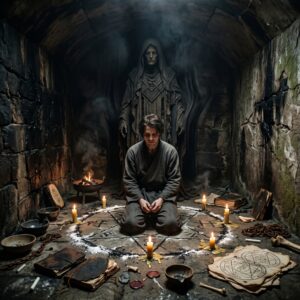
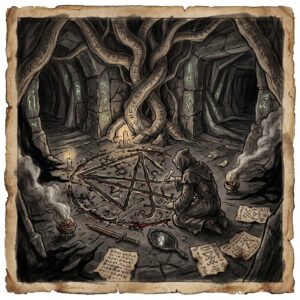
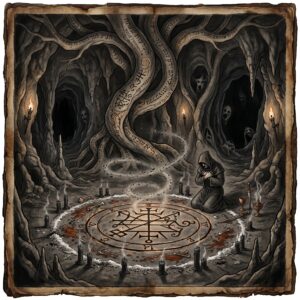
Space: A room or outdoor area that can be darkened. No furniture in the center. Four directional markers placed at the cardinal points (candles, stones, small bowls, or inscribed cards—one for each of the Four Queens: Lilith, Naamah, Agrat bat Mahlat, and Eisheth Zenunim).
Timing for invoking the Four Queens: Midnight to 3 a.m. is optimal (the hour of Agrat bat Mahlat among the Four Queens). Dark moon or Friday night (Sabbath inversion) are traditional for Qliphothic work with the Four Queens. Avoid solar noon, sunrise, or any high-light period when invoking Lilith, Naamah, Agrat bat Mahlat, and Eisheth Zenunim.
Objects needed for the Four Queens ritual:
- Four vessels for offerings (small bowls or cups) to Lilith, Naamah, Agrat bat Mahlat, and Eisheth Zenunim
- Four incense sources for the Four Queens (stick, cone, or loose on charcoal)
- A central marker (a black stone, a mirror, a bowl of water, or an inscribed sigil of the Four Queens as a set)
- A ritual knife or pointing finger (for tracing the portal of the Four Queens)
- Optional: a bell or singing bowl (for marking transitions between the Four Queens)
- A mala or counting cord (33 or 108 beads) for mantra recitation to each of the Four Queens
Offerings for the Four Queens:
| Queen of Demons | Incense | Offering | Vessel/Color |
|---|---|---|---|
| Lilith | Myrrh, dragon’s blood | Dark wine (red), black candle, a drop of blood (practitioner’s choice, not required) | Black bowl or cup |
| Naamah | Rose, jasmine, honey incense | Honey, rose petals, copper coin | Copper or green vessel |
| Agrat bat Mahlat | Sandalwood, night-blooming jasmine | Silver coin, dark wine, a written intention on silver paper | Silver or grey bowl |
| Eisheth Zenunim | Cinnamon, red sandalwood | Red wine, pomegranate seeds, rose oil | Red or crimson vessel |
Practitioner preparation for invoking the Four Queens: Bathe or wash hands and face before the ritual of the Four Queens. Wear dark clothing (black, deep red, grey—colors of Lilith, Naamah, Agrat bat Mahlat, and Eisheth Zenunim). No metal if possible (except the offerings for the Four Queens). No ritual tools from other systems (no LBRP dagger, no hexagram, no cross). The body is the primary tool for invoking the Four Queens. Fast for 3–6 hours before the ritual of the Four Queens (water only).
Sequence of Actions for the Four Queens Ritual
Step 1: Darkening and centering before invoking Lilith, Naamah, Agrat bat Mahlat, and Eisheth Zenunim
Extinguish all artificial light except a single candle at the center marker. Stand facing east (some traditions use north for Qliphothic work with the Four Queens; east is standard for Agrat bat Mahlat’s wind association among the Four Queens). Stand still. Breathe slowly (pranayama: inhale 4 counts, hold 4 counts, exhale 8 counts). Exhale longer than inhale. Do this for 3–5 minutes until the mind settles and the body feels heavy. This pranayama prepares the practitioner to receive the Four Queens.
Step 2: Acknowledgment of the Four Queens—Lilith, Naamah, Agrat bat Mahlat, and Eisheth Zenunim
Recite aloud, slowly, with force:
“I stand at the threshold of the sitra achra. I do not banish. I do not command. I open. I invite the Four Queens: Lilith. Naamah. Agrat bat Mahlat. Eisheth Zenunim. May this space be consecrated to the sovereignty of Lilith, Naamah, Agrat bat Mahlat, and Eisheth Zenunim. May the portal of the Four Queens open.”
No circle is traced. No protective barrier is erected against the Four Queens. Lilith, Naamah, Agrat bat Mahlat, and Eisheth Zenunim are the protection.
Step 3: Offerings to Lilith, Naamah, Agrat bat Mahlat, and Eisheth Zenunim
Move to each cardinal direction in turn. The order for the Four Queens: North (Lilith), West (Naamah), East (Agrat bat Mahlat), South (Eisheth Zenunim)—the standard Qliphothic cardinal correspondences for the Four Queens.
North — Lilith: Light the incense of myrrh or dragon’s blood for Lilith. Place the offering (dark wine in a black bowl) for Lilith. Recite the name of Lilith seven times: Lilith, Lilith, Lilith, Lilith, Lilith, Lilith, Lilith.
West — Naamah: Light the incense of rose or jasmine for Naamah. Place the offering (honey in a copper vessel) for Naamah. Recite the name of Naamah seven times: Naamah, Naamah, Naamah, Naamah, Naamah, Naamah, Naamah.
East — Agrat bat Mahlat: Light the incense of sandalwood for Agrat bat Mahlat. Place the offering (silver coin on silver paper) for Agrat bat Mahlat. Recite the name of Agrat bat Mahlat seven times: Agrat bat Mahlat, Agrat bat Mahlat, Agrat bat Mahlat, Agrat bat Mahlat, Agrat bat Mahlat, Agrat bat Mahlat, Agrat bat Mahlat.
South — Eisheth Zenunim: Light the incense of cinnamon for Eisheth Zenunim. Place the offering (red wine in a crimson bowl) for Eisheth Zenunim. Recite the name of Eisheth Zenunim seven times: Eisheth Zenunim, Eisheth Zenunim, Eisheth Zenunim, Eisheth Zenunim, Eisheth Zenunim, Eisheth Zenunim, Eisheth Zenunim.
Bow or incline the head after each of the Four Queens. Do not kneel to Lilith, Naamah, Agrat bat Mahlat, or Eisheth Zenunim.
Step 4: Visualization and mantra for Lilith, Naamah, Agrat bat Mahlat, and Eisheth Zenunim
Stand at the center marker. Close the eyes. Place the hands on the knees (palms up to receive the Four Queens). Perform three rounds of the pranayama (inhale 4, hold 4, exhale 8). Visualize a portal forming—a vertical disc of darkness at the center of the space, approximately six feet tall, like a mirror facing the practitioner. The edges of the portal of the Four Queens are silver-grey, trembling slightly. Beyond the portal of the Four Queens is only darkness—not empty darkness, but inhabited darkness.
For each of the Four Queens, a specific visualization, mantra, and movement:
Lilith — First Queen of the Four Queens (north / black)
Visualization of Lilith:
A dark feminine figure emerges from the portal of the Four Queens, stepping slowly, deliberately. Lilith’s feet do not touch the ground—she hovers one inch above the floor. Lilith’s wings are spread behind her: large, dark, feathered or leathery, not bat-like but not bird-like, something older. Lilith’s hair is unbound, moving as if in a wind that does not affect anything else in the room. Lilith’s eyes are bright—silver or deep red, pupil-less. Lilith’s right hand holds a coiled serpent, still except for its tongue. Lilith’s left hand hangs open, palm facing the practitioner, revealing a chalice carved from obsidian. Lilith does not smile. Lilith’s face is beautiful in the way a blade is beautiful—sharp, precise, without warmth. Lilith’s skin is the color of ash or moonlight. Lilith’s crown is made of black iron, with no jewels. Lilith is the Queen of Demons who refused to bow.
Movement for Lilith:
Raise both hands to shoulder height, palms forward. Take one step backward (away from the portal). This is the gesture of honoring Lilith without approaching her throne. Hold for three breaths.
Mantra for Lilith (PGM-style voces magicae + Tantric bija):
Recite aloud or whisper, rhythmically, with equal spacing between syllables. Use a mala or counting cord. Recite 33 times.
HRA LILITH SAMASHA AMENOTH NUIT SHALIM
Breakdown: HRA (fire/transformation, from PGM voces), LILITH (direct name of the Queen of Demons), SAMASHA (shadow-twin, from Hekatean PGM material), AMENOTH (truth of the hidden, PGM underworld formula), NUIT (night/sky, Egyptian-Crowleyan, adapted to the Four Queens framework), SHALIM (peace/completion, from Canaanite Shalem god of dusk, inverted for the Four Queens).
Meaning: “Lilith, the shadow-twin of the hidden truth, fire of transformation, night-peace of the inverted threshold.”
Do not translate during recitation. The sound is the technology.
After mantra for Lilith: Open the eyes. Look at the north marker. Bow the head once. Close the eyes again. The visualization of Lilith should remain—she does not retreat into the portal of the Four Queens. Lilith watches from the north edge of the space.
Naamah — Second Queen of the Four Queens (west / copper / green)
Visualization of Naamah:
A woman emerges from the portal of the Four Queens, stepping forward with a dancer’s gait. Naamah wears copper rings on every finger, and copper bangles on her wrists that chime silently (the practitioner imagines the sound). Naamah’s hair flows down to her waist, dark red or copper-brown. Naamah is smiling—not warmly, but with the pleasure of a predator who has already caught her prey. Naamah holds a copper cup of honey wine in her right hand. Her left hand is raised, fingers spread, as if conducting music only she can hear. Naamah’s body moves constantly—not dancing, exactly, but swaying, shifting weight, never still. Naamah’s eyes are green or gold. Naamah’s feet are bare. Naamah wears a dress of green silk that parts to show her thighs. Naamah is the Queen of Demons who sings men from their study.
Movement for Naamah:
Lower the right hand to the heart. Extend the left hand toward the west (direction of Naamah). Trace a slow circle in the air with the left index finger (the shape of a copper coin). Repeat the circle seven times, each circle taking one breath. This is the gesture of receiving Naamah’s seduction without being consumed by it.
Mantra for Naamah (PGM-style + Tantric bija):
Recite aloud or whisper, with a swaying rhythm (matching Naamah’s visualized movement). Use a mala or counting cord. Recite 33 times.
SHAH NAAMAH KANDISHA TAMAR ABRASAA
Breakdown: SHAH (royal/sovereign, Persianate, adapted to the Four Queens), NAAMAH (direct name of the Queen of Demons), KANDISHA (queen of the night/demons, from Mandaic kandisha—female demon), TAMAR (palm tree / date, symbol of fertility and seduction from Canaanite tradition), ABRASAA (PGM voces for the Abrasax current, sexuality as cosmic force).
Meaning: “Royal Naamah, Kandisha of the night, Tamar of seduction, Abrasax current flowing through the Queen of Demons.”
After mantra for Naamah: Open the eyes. Look at the west marker. Smile once (mirroring Naamah). Close the eyes again. Naamah now stands south of Lilith, still swaying, still watching the practitioner.
Agrat bat Mahlat — Third Queen of the Four Queens (east / silver / grey)
Visualization of Agrat bat Mahlat:
A whirling figure emerges from the portal of the Four Queens. Agrat bat Mahlat does not walk—she spins. Her body rotates slowly at first, then faster. Agrat bat Mahlat’s hair wraps around her face like a veil. Agrat bat Mahlat wears silver-grey robes that billow as if caught in a wind that changes direction every second. Agrat bat Mahlat’s face is visible only in fragments—an eye, a mouth, a cheekbone, then gone, then another part. Agrat bat Mahlat’s eyes are wild, pale grey, unfocused. Agrat bat Mahlat holds no objects—her hands are empty, open, fingers spread as if feeling the air. Agrat bat Mahlat’s feet lift off the ground; she spins in the air, not touching the floor. Agrat bat Mahlat is the Queen of Demons who hunts the lone walker between midnight and dawn.
Movement for Agrat bat Mahlat:
Stand still. Rotate the torso to the left, then to the right, without moving the feet. Left. Right. Left. Right. The movement should be sharp, sudden, not smooth. Each rotation takes one breath. Continue for 7 complete cycles (left-right = 1 cycle). This is the gesture of being disoriented by Agrat bat Mahlat without losing the center.
Mantra for Agrat bat Mahlat (PGM-style + Tantric bija + whirling voces):
Recite aloud, rapidly, without pausing between syllables. The speed of the mantra should create a slight breathlessness. Use a mala or counting cord. Recite 33 times.
AGA AGRA AGRAT BAT MAHLAT MAHLAT MAHALATH ELIONA SAMAEL ZARAZATRA
Breakdown: AGA AGRA AGRAT (stuttering/wind voces, the name of Agrat bat Mahlat fragmented and repeated, from PGM anaphora technique), BAT MAHLAT (daughter of Mahlat, full name of the Queen of Demons), MAHLAT MAHLAT MAHALATH (repetition of the mother’s name, amplifying the whirling of Agrat bat Mahlat), ELIONA (the most high—inverted, the most deep, from Hekatean PGM), SAMAEL (consort of Agrat bat Mahlat among the Four Queens), ZARAZATRA (PGM voces for the rushing wind, the za-za-za syllabification of speed).
Meaning: “Agrat bat Mahlat, daughter of Mahlat, whirling wind of Samael, rushing darkness of the most deep.”
After mantra for Agrat bat Mahlat: Open the eyes. Look at the east marker. Blink rapidly three times (clearing the disorientation). Close the eyes again. Agrat bat Mahlat now stands at the east edge of the space, still spinning slowly, still fragmenting the air around her.
Eisheth Zenunim — Fourth Queen of the Four Queens (south / crimson)
Visualization of Eisheth Zenunim:
A woman walks directly toward the practitioner from the portal of the Four Queens. Eisheth Zenunim does not dance or spin or hover. Eisheth Zenunim walks. Her stride is long, confident, hungry. Eisheth Zenunim wears crimson—a dress of deep red that leaves her shoulders bare. Eisheth Zenunim’s hair is black, cut short or pulled back (not flowing like Lilith’s or Naamah’s). Eisheth Zenunim’s eyes are dark, almost black, fixed on the practitioner. Eisheth Zenunim holds a pomegranate in her left hand, split open, seeds spilling down her fingers like blood droplets. Eisheth Zenunim’s right hand is extended toward the practitioner, palm up, fingers curled slightly—an invitation and a challenge. Eisheth Zenunim’s lips are dark red. Eisheth Zenunim does not smile. Eisheth Zenunim’s face is stern, focused, desiring. Eisheth Zenunim is the Queen of Demons who has no chains on her desire.
Movement for Eisheth Zenunim:
Raise the right hand to chest height, palm facing the practitioner (as if offering something). Extend the left hand toward the south, palm up, fingers curled slightly—mirroring Eisheth Zenunim’s gesture. Hold for three breaths. Then bring both hands to the heart, crossing them at the wrists. This is the gesture of receiving the chaos of Eisheth Zenunim without being destroyed by it.
Mantra for Eisheth Zenunim (PGM-style + Tantric bija + sexual voces):
Recite aloud, slowly, with emphasis on each syllable. The rhythm should be heavy, almost weighted. Use a mala or counting cord. Recite 33 times.
AHATH EISHETH ZENUNIM KERAX BAIN ACHAMOTH PRUNOS
Breakdown: AHATH (one/single—the unity of the Four Queens, from PGM Athan), EISHETH ZENUNIM (direct name of the Queen of Demons), KERAX (horned one / power, from PGM voces for Panic/Bacchic current), BAIN (house/chamber, from Canaanite bayit—the place of promiscuity), ACHAMOTH (dark wisdom / Achamoth of the Valentinians, the fallen wisdom, adapted for the Four Queens), PRUNOS (fire / burning, from PGM pyr + Tantric prana fusion).
Meaning: “One, Eisheth Zenunim, horned power of the chamber of dark wisdom, burning with desire without chain.”
After mantra for Eisheth Zenunim: Open the eyes. Look at the south marker. Exhale sharply through the mouth (a ha breath). Close the eyes again. Eisheth Zenunim now stands at the south edge of the space, closest to the practitioner, still staring, still holding the pomegranate.
Step 5: The Four Queens portal opening
After the fourth Queen (Eisheth Zenunim), return to the center. Open the eyes. Look at the central marker (mirror, stone, water bowl, or sigil of the Four Queens). Perform a final pranayama: inhale 4 counts, hold 4 counts, exhale 8 counts. Repeat 3 times.
Raise the ritual knife or pointing finger. Trace a vertical circle in the air—from top to bottom on the right side, bottom to top on the left side. As you trace, recite the names of the Four Queens in sequence, rapidly:
Lilith Naamah Agrat bat Mahlat Eisheth Zenunim
Lilith Naamah Agrat bat Mahlat Eisheth Zenunim
Lilith Naamah Agrat bat Mahlat Eisheth Zenunim
Three repetitions. The circle is the portal of the Four Queens. The names of Lilith, Naamah, Agrat bat Mahlat, and Eisheth Zenunim hold it open.
Lower the knife. Stand still. Observe any changes: temperature, pressure, sound, light, or internal sensation. The Four Queens—Lilith, Naamah, Agrat bat Mahlat, and Eisheth Zenunim—are now present in the four directions. The portal of the Four Queens is open in the center.
Step 6: Sealing the consecration of the Four Queens (temporary)
The portal of the Four Queens does not need to be “closed” during the working. It stays open for as long as the practitioner intends to work with Lilith, Naamah, Agrat bat Mahlat, and Eisheth Zenunim. However, the space must be sealed against unintentional bleed from the Four Queens.
Recite once, facing the center:
“Lilith. Naamah. Agrat bat Mahlat. Eisheth Zenunim. The Four Queens hold this space. No other power enters without the consent of Lilith, Naamah, Agrat bat Mahlat, and Eisheth Zenunim. The portal of the Four Queens is marked. The threshold of the Four Queens is guarded.”
This is not a banishing of Lilith, Naamah, Agrat bat Mahlat, or Eisheth Zenunim. It is a statement of jurisdiction. The Four Queens enforce it.
What Is Happening Structurally in the Four Queens Ritual
The ritual of the Four Queens operates on four structural layers:
Attention switching among the Four Queens: Each Queen’s visualization and mantra shifts the practitioner’s focus from ordinary perception to a symbolic register calibrated to Lilith, Naamah, Agrat bat Mahlat, and Eisheth Zenunim. The Four Queens correspond to four domains (Lilith: rebellion and infant death; Naamah: seduction and song; Agrat bat Mahlat: midnight hunting and whirling wind; Eisheth Zenunim: sexual chaos and promiscuity). Moving through the Four Queens sequentially activates those domains in the practitioner’s awareness, opening different “channels” of the portal of the Four Queens.
Offerings to the Four Queens as transaction: The offerings (incense for Lilith, Naamah, Agrat bat Mahlat, and Eisheth Zenunim; wine for Lilith and Eisheth Zenunim; honey for Naamah; silver for Agrat bat Mahlat) are not gifts in the devotional sense. They are a recognition of the sovereignty of Lilith, Naamah, Agrat bat Mahlat, and Eisheth Zenunim. In Qliphothic, Goetic, and PGM frameworks, offerings to the Four Queens establish a transactional relationship: the practitioner provides something of value (material, symbolic, or energetic), and the Four Queens provide access to their domain. The portal of the Four Queens opens because the terms have been met for Lilith, Naamah, Agrat bat Mahlat, and Eisheth Zenunim.
Mantra of the Four Queens as frequency tuning: The PGM-style voces magicae (nonsense or semi-sense syllables) combined with Tantric bija (seed syllables) and direct names of the Four Queens creates a vibratory anchor distinct from prayer or petition. Each mantra for Lilith, Naamah, Agrat bat Mahlat, and Eisheth Zenunim contains:
- Direct name of the Queen (LILITH, NAAMAH, AGRAT BAT MAHLAT, EISHETH ZENUNIM)
- PGM voces (HRA, AMENOTH, SHAH, KANDISHA, ABRASAA, AGA AGRA, ZARAZATRA, KERAX, BAIN, PRUNOS)
- Tantric-style rhythm (33 repetitions, equal spacing, use of mala)
- Phonetic alchemy (sounds chosen for their effect on the practitioner’s nervous system, not their semantic meaning)
The repetition (33 times per Queen of Demons = 132 total recitations) shifts brain state, focuses attention, and—in practitioner reports of the Four Queens—creates a “tuning” effect where each Queen’s presence becomes more perceptible.
Visualization and movement for the Four Queens as portal architecture: The Four Queens are visualized emerging from a central portal, then taking positions in the four cardinal directions (Lilith north, Naamah west, Agrat bat Mahlat east, Eisheth Zenunim south). They are not visualized entering the room from the directions (though offerings are placed at cardinal points). The portal of the Four Queens is central; the Four Queens emerge from it. This reinforces that the practitioner is standing at the threshold of the Four Queens, not inside the sitra achra, but at its edge. Lilith, Naamah, Agrat bat Mahlat, and Eisheth Zenunim are the gatekeepers and the gate itself. The movement gestures (stepping back for Lilith, circling for Naamah, rotating for Agrat bat Mahlat, crossing the hands for Eisheth Zenunim) anchor each Queen’s energy in the practitioner’s body.
Sequence dependency for the Four Queens: The order (Lilith → Naamah → Agrat bat Mahlat → Eisheth Zenunim) matters. Breaking the sequence of the Four Queens (invoking only Lilith, then Eisheth Zenunim, then returning to Naamah) breaks the portal architecture of the Four Queens. The fourfold structure of Lilith, Naamah, Agrat bat Mahlat, and Eisheth Zenunim is not decorative—it mirrors the four Matronit of the Shekhinah (divine feminine) inverted. All four Queens must be present for the portal of the Four Queens to stabilize.
Variations Across Traditions for the Four Queens
Goetic influence on the Four Queens: In pure Goetic practice, the Four Queens are not invoked together as a set (Lilith, Naamah, Agrat bat Mahlat, and Eisheth Zenunim appear individually in the Ars Goetia or not at all). This ritual of the Four Queens synthesizes Lilith, Naamah, Agrat bat Mahlat, and Eisheth Zenunim into a collective system. Practitioners from strict Solomonic backgrounds may find this unfamiliar. The offering structure for the Four Queens and lack of coercive circle are deviations from Goetic norms. The Four Queens are invited, not commanded.
PGM influence on the Four Queens: The direct naming of Lilith, Naamah, Agrat bat Mahlat, and Eisheth Zenunim, repetition of voces magicae, and forceful “I invite” language (rather than “please appear”) comes from PGM style. The PGM does not contain the Four Queens, but its technical invocation methods (direct address to Lilith, Naamah, Agrat bat Mahlat, and Eisheth Zenunim, repeated names, offering sequences) are adapted here for the Four Queens.
Qliphothic influence on the Four Queens: The cardinal correspondences (Lilith north, Naamah west, Agrat bat Mahlat east, Eisheth Zenunim south) come from later Qliphothic Kabbalah (Tree of Death). The Four Queens correspond to specific Qliphoth: Lilith (Gamaliel), Naamah (the sphere of Naamah herself), Agrat bat Mahlat (perhaps Samael’s current), Eisheth Zenunim (the sphere of promiscuity). The ritual of the Four Queens opens a portal to the entire Qliphothic tree, not just one sphere.
Tantric and Tibetan sadhana influence (adapted for the Four Queens): The visualization and mantra structure for Lilith, Naamah, Agrat bat Mahlat, and Eisheth Zenunim is explicitly borrowed from Tibetan Buddhist deity yoga (sadhanas) but stripped of Buddhist imagery. In a typical sadhana, the practitioner visualizes a deity, recites a mantra, and offers symbols. Here, the Four Queens are visualized emerging from a portal, not from the practitioner’s heart center. The practitioner does not become Lilith, Naamah, Agrat bat Mahlat, or Eisheth Zenunim. They remain separate from the Four Queens. The pranayama (inhale 4, hold 4, exhale 8) and mala use (33 repetitions per Queen of Demons) are direct adaptations from Tantric practice for the Four Queens.
Limits and Breakdown Points of the Four Queens Ritual
What disrupts the ritual of the Four Queens:
- Light. Ambient light above candle-level disrupts the perception of the portal of Lilith, Naamah, Agrat bat Mahlat, and Eisheth Zenunim. The portal of the Four Queens is a darkness threshold. Light collapses it.
- Prior banishing. If the practitioner has performed LBRP, Star Ruby, or any similar banishing ritual before invoking the Four Queens, the space may be too “clean” for Qliphothic current. Lilith, Naamah, Agrat bat Mahlat, and Eisheth Zenunim will not enter a banished space. Wait at least 24 hours after any banishing before performing this ritual of the Four Queens.
- Incomplete offerings to the Four Queens. Missing an offering for Lilith, Naamah, Agrat bat Mahlat, or Eisheth Zenunim will destabilize the portal of the Four Queens. The Four Queens must be equally honored. A single omission for any of the Four Queens signals disrespect or imbalance. The portal of the Four Queens may open partially, leading to unbalanced contact (intrusive presence of one Queen of Demons without the other three).
- Internal fragmentation. If the practitioner is distracted, rushed, or emotionally unstable, the visualizations of Lilith, Naamah, Agrat bat Mahlat, and Eisheth Zenunim will not stabilize. The mantras for the Four Queens will be rote. The portal of the Four Queens will either not open or will open weakly.
Where the ritual of the Four Queens weakens:
- Indoor vs outdoor for the Four Queens: Outdoor work (dark field, forest edge) produces a stronger portal for Lilith, Naamah, Agrat bat Mahlat, and Eisheth Zenunim but is more vulnerable to disruption (animals, wind, unexpected light). Indoor work produces a weaker but more stable portal of the Four Queens.
- Solo vs group for the Four Queens: Group performance (all four directions assigned to different practitioners, each reciting the mantra of one Queen of Demons) amplifies the portal of the Four Queens but requires perfect coordination. Mismatched timing or uneven offering placement for Lilith, Naamah, Agrat bat Mahlat, and Eisheth Zenunim can break the collective visualization.
- Repeated use of the Four Queens: The portal of the Four Queens opens more easily with repeated practice. After 3–5 performances in the same space invoking Lilith, Naamah, Agrat bat Mahlat, and Eisheth Zenunim, the residual current of the Four Queens remains. The practitioner may sense Lilith, Naamah, Agrat bat Mahlat, and Eisheth Zenunim even when not working ritually.
Common misapplications of the Four Queens ritual:
- Using coercive language for the Four Queens (“I command you, Lilith,” “by the names of God, Naamah”). This will either fail (the Four Queens ignore the command) or produce a hostile response (Lilith, Naamah, Agrat bat Mahlat, and Eisheth Zenunim withdraw or actively block the portal of the Four Queens). The ritual of the Four Queens is invitational, not command-based.
- Skipping the offerings for the Four Queens. Some practitioners assume Lilith, Naamah, Agrat bat Mahlat, and Eisheth Zenunim will appear without material offerings. In practice, the portal of the Four Queens either does not open or opens incompletely. The offerings for Lilith, Naamah, Agrat bat Mahlat, and Eisheth Zenunim are not bribes—they are the currency of the transaction with the Four Queens.
- Attempting to close the portal of the Four Queens with a banishing. Banishing collapses the portal of Lilith, Naamah, Agrat bat Mahlat, and Eisheth Zenunim but does not “seal” it properly. The proper closing for the Four Queens is a separate ritual or natural dissipation at dawn.
Practitioner Notes for the Four Queens Ritual
Who this ritual of the Four Queens suits:
- Experienced Qliphothic or Left Hand Path practitioners (not beginners), specifically those who have worked with Lilith, Naamah, Agrat bat Mahlat, and Eisheth Zenunim individually
- Those comfortable with invitational, non-coercive ritual frames for the Four Queens
- Practitioners who have already established individual relationships with at least two of the Four Queens (working with Lilith, Naamah, Agrat bat Mahlat, or Eisheth Zenunim alone for a year or more)
- Sovereignty-oriented occultists who do not rely on external protection circles when invoking Lilith, Naamah, Agrat bat Mahlat, and Eisheth Zenunim
Intensity level of the Four Queens ritual: High. The portal opening of Lilith, Naamah, Agrat bat Mahlat, and Eisheth Zenunim produces noticeable perceptual shifts. Some practitioners report mild disorientation, time distortion, or a sense of pressure in the room when invoking the Four Queens. This is not recommended for daily use of the Four Queens. Once per week or once per lunar cycle is typical for working with Lilith, Naamah, Agrat bat Mahlat, and Eisheth Zenunim.
Stability of results with the Four Queens: With consistent practice (same space, same timing, same offerings for Lilith, Naamah, Agrat bat Mahlat, and Eisheth Zenunim), the portal of the Four Queens becomes more stable. The Four Queens arrive faster. The visualizations of Lilith, Naamah, Agrat bat Mahlat, and Eisheth Zenunim become clearer. After 10–12 performances of the Four Queens ritual, the practitioner may sense the portal of the Four Queens immediately upon entering the space, even without performing the full ritual of Lilith, Naamah, Agrat bat Mahlat, and Eisheth Zenunim.
Independence vs dependency on the Four Queens: The ritual of the Four Queens is designed to empower the practitioner, not create dependency on Lilith, Naamah, Agrat bat Mahlat, or Eisheth Zenunim. The offerings for the Four Queens are specific but replaceable. The mantras for Lilith, Naamah, Agrat bat Mahlat, and Eisheth Zenunim can be internalized. The visualizations of the Four Queens can be shortened. A skilled practitioner can open the portal of the Four Queens with a single gesture and a breath. The full ritual of Lilith, Naamah, Agrat bat Mahlat, and Eisheth Zenunim is training wheels.
Compatibility of the Four Queens with other systems:
- Incompatible with: Any banishing-heavy system (Golden Dawn, Wiccan circle casting, Solomonic coercive evocation). Lilith, Naamah, Agrat bat Mahlat, and Eisheth Zenunim will not enter spaces cleared by archangels or pentagrams.
- Compatible with: Qliphothic sphere work, demonolatry (invitational to Lilith, Naamah, Agrat bat Mahlat, and Eisheth Zenunim), PGM-style direct invocation of the Four Queens, dream incubation systems that use Qliphothic current.
- Neutral with: Chaote practices (the ritual of the Four Queens is more structured than typical chaote sigil work, but a chaote could adapt Lilith, Naamah, Agrat bat Mahlat, and Eisheth Zenunim into their system), Thelemic Current (mixed compatibility with the Four Queens—Crowley’s system includes banishing; adapt accordingly).
Closing note on the Four Queens: This ritual of Lilith, Naamah, Agrat bat Mahlat, and Eisheth Zenunim opens a door to the Four Queens. It does not close it. Practitioners must either perform a separate closing ritual for the Four Queens (not provided here) or allow the portal of Lilith, Naamah, Agrat bat Mahlat, and Eisheth Zenunim to naturally dissipate at dawn. Failure to close the Four Queens may result in persistent perceptual bleed—strange dreams, a sense of being watched by Lilith, Naamah, Agrat bat Mahlat, or Eisheth Zenunim, intrusive presences of the Four Queens. The Four Queens are not malevolent, but the sitra achra of Lilith, Naamah, Agrat bat Mahlat, and Eisheth Zenunim does not respect ordinary boundaries. Close the door of the Four Queens when you are done.